

Introduction: When Laughter Defies Logic
Have you ever watched an Indian film where a character stops mid-scene to talk about the meaning of life, or where the rules of reality seem to bend without warning? If that sounds familiar, you have already tasted indian alternative cinema at its most playful. This is a world where stories refuse to behave, where humor does not follow the usual setup-punchline formula, and where strange jokes actually make a deeper kind of sense.
Indian alternative cinema has a rich tradition of surreal and absurdist humor that often goes unrecognized. While mainstream Bollywood relies on predictable comedy tracks and familiar tropes, the alternative scene has quietly built something different. Think of films that explore parallel realities or challenge how we see everyday life. As explored in discussions about movie parallel society movies, these stories create tension between coexisting truths. That same tension powers the best absurdist comedy in Indian film.
Here is the problem. Fans of absurdist humor struggle to find clear explanations and curated examples of this niche within Indian film. You might know the classics from world cinema. You might even know how certain Hollywood actors, like the ones we discuss in our analysis of Julia Roberts absurdist humor or Keanu Reeves absurdist humor, use surreal comedy to subvert expectations.

But when it comes to Indian alternative cinema, the resources are scattered and hard to find.
This article provides an accessible, research-backed guide to understanding and appreciating absurdist elements in Indian alternative cinema. Whether you are looking for alien movies with a philosophical twist, new movies to stream that break the mold, or even connections to literary works like the book thief, we will explore how absurdist humor lives and breathes in Indian cinema.
Let us begin this strange, wonderful journey together. And if you want to dive deeper into the theory behind these comedic styles, feel free to contact us to discuss essays, analysis, or creative workshops about surreal and absurd comedy.
What Is Indian Alternative Cinema? A Brief History of the Unconventional
Indian alternative cinema is a term that gets thrown around a lot. Some people use it to mean the same thing as parallel cinema. But it is actually bigger than that.
Parallel cinema started in the 1950s as a realistic art film movement in places like West Bengal. It was a direct response to the song and dance formulas of mainstream Bollywood. As one analysis explains, the term "parallel cinema" is often misused as a label for unconventional and experimental cinema. Indian alternative cinema includes all of that. But it also includes films that are consciously weird, absurd, or surreal.
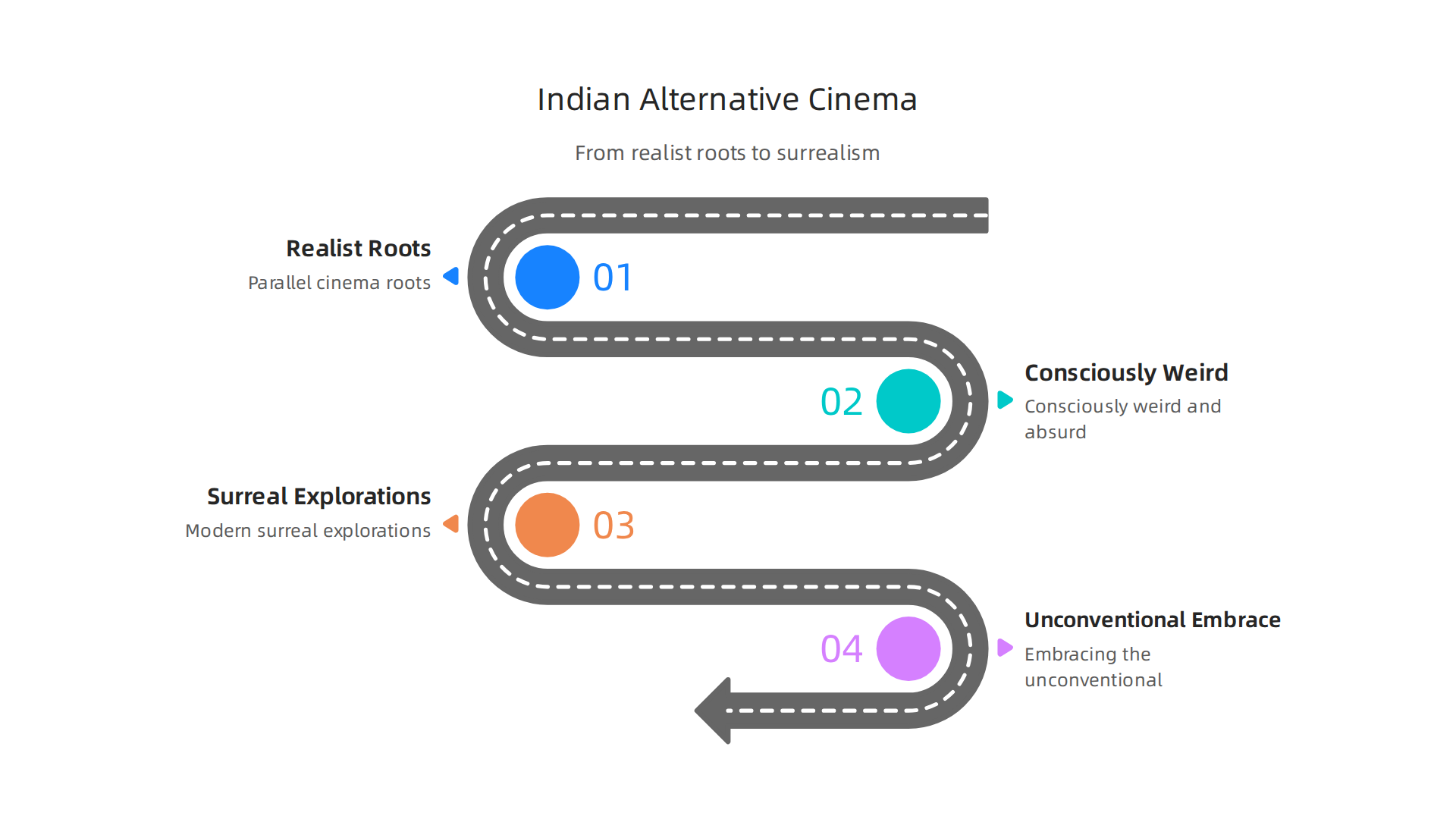
It is a big tent for any film that refuses to follow the usual rules.
The movement studied formally as Indian parallel cinema gained traction in the 1970s. The BFI notes that Indian Parallel Cinema came of age in the late 1960s.

But its creative roots go back even further. Directors like Ritwik Ghatak were telling raw, poetic stories that did not fit any easy category. Then Shyam Benegal came along in the 1970s and brought this offbeat style to a wider audience. These pioneers proved that you could make films that were both deeply Indian and utterly unconventional.
Here is where things get interesting for fans of strange comedy. By the 1990s and 2000s, a new wave of filmmakers took the experimental spirit of alternative cinema and twisted it into something surreal. Directors like Anurag Kashyap and Qaushiq Mukherjee started playing with absurdist humor. They broke reality on purpose. Characters acted in ways that did not make logical sense, but they made emotional sense. This is the same spirit that powers the best absurdist comedy around the world.
If you enjoy films where the rules of reality bend, you might also enjoy how Hollywood stars use similar tricks. For example, we have explored how Julia Roberts uses absurdist humor to subvert romantic comedies. And Keanu Reeves uses deadpan comedy to create his own brand of surreal humor. These same techniques show up in the best Indian alternative cinema.
If you enjoy unconventional stories like the book thief, which plays with narration and perspective, you will love how Indian alternative cinema bends the rules of storytelling. This history of rule-breaking paved the way for modern alien movies with a philosophical twist, the kind we recommend when you are looking for new movies to stream that break the mold.
This tradition of bending reality lives on. If you enjoy strange logic and smarter laughs, explore The Ridiculous series. It carries that same playful, rule-breaking energy into a cosmic, funny universe. You can even start with Book 1 on Amazon to see how far you can stretch a joke. And if you want to dive deeper into the theory, feel free to contact us to discuss the mechanics of surreal comedy.
The Absurdist Toolkit: Key Techniques in Indian Surreal Films
Now that you understand the history of Indian alternative cinema, let us look at the specific tools these filmmakers use. What makes their surreal comedy work so well? It turns out they rely on a few repeatable techniques. And you can use them too.
Here is the toolkit that keeps showing up in the best Indian surreal films.
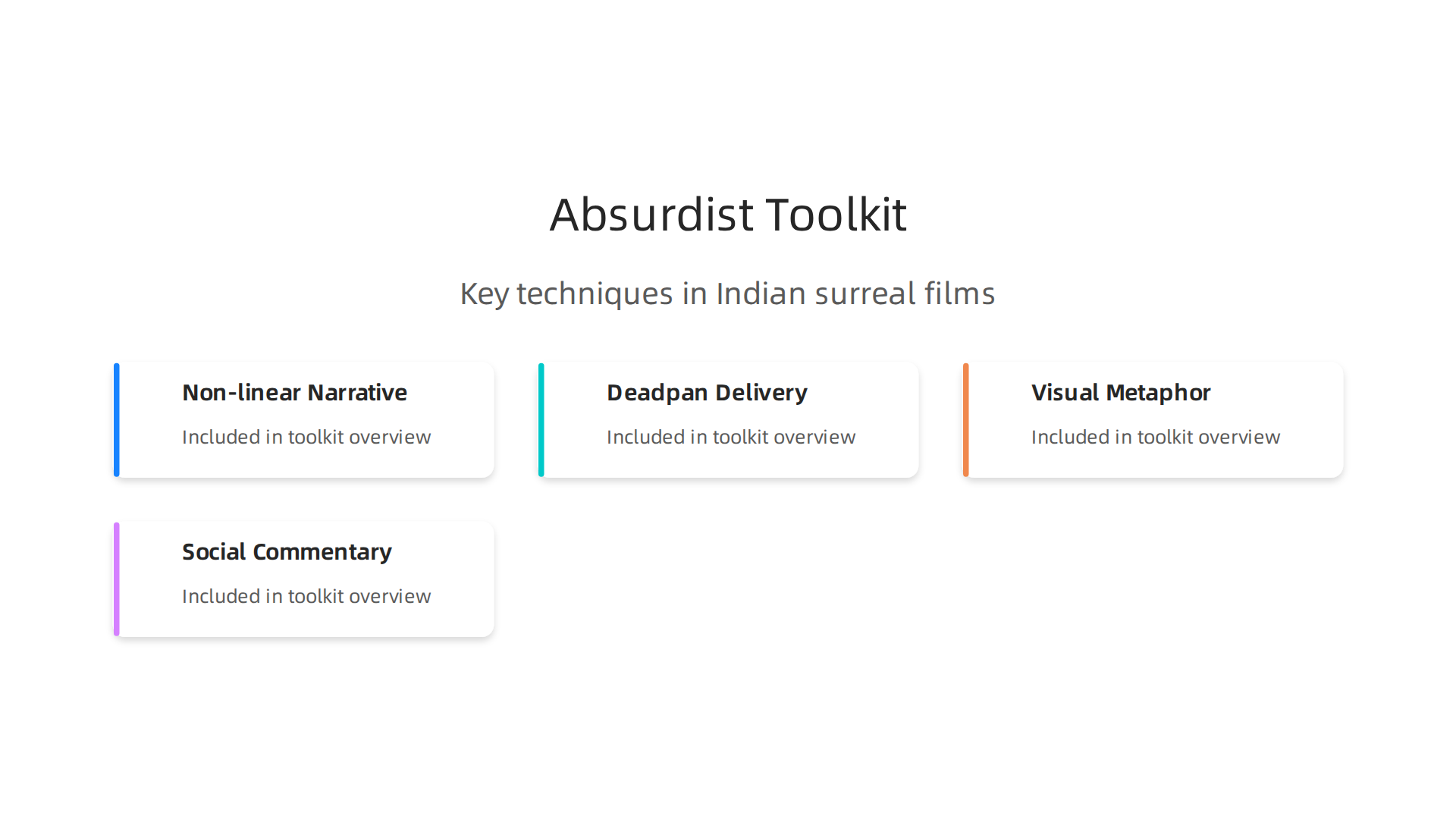
Non-Linear Narratives
Most mainstream Bollywood movies tell stories in a straight line. Start here. End there. Indian alternative cinema throws that rule out the window.
Filmmakers jump between timelines without warning. A character might be a child in one scene and an old person in the next. Reason? Emotion matters more than chronology. This unconventional narrative structure creates confusion on purpose. And that confusion is the point. It forces you to feel lost, the same way the characters do.
Have you ever watched a movie where you had no idea when the story was taking place? That is the technique at work. It breaks your expectations so you stay alert.
Deadpan Delivery
Here is a trick that works wonders in Indian surreal comedy. Actors deliver the strangest lines with a completely straight face.
A man might talk to a ghost as if he is ordering tea. A woman might casually mention that the government is run by alien lizards. No laugh track. No wink to the camera. Just pure serious delivery of absurd content.
This technique creates a gap between what the character says and what the audience knows is true. That gap is where the comedy lives. If you want to see how this works in global cinema, check out how Keanu Reeves uses deadpan comedy to create his own brand of surreal humor. The same principle applies here.
Visual Metaphor
Indian filmmakers love to show you what a character feels instead of telling you.
A character who feels trapped might literally become a bird in a cage. A man losing his mind might see the walls closing in around him. These visual metaphors blend surreal elements with social satire. They make a point about Indian society while also being deeply strange.
Take a film like "Jil Jung Juk" for example. It uses a futuristic Western style to comment on modern India. The absurd visuals are not just for fun. They carry real meaning underneath.
Blending Absurdity with Social Commentary
This might be the most important technique in the toolkit. Indian alternative cinema rarely uses absurd comedy just for laughs. The humor and satire are rooted in real Indian socio-political realities. When a character does something completely ridiculous, it is usually pointing at something true about the world.
A film might show a politician turning into a donkey. That is funny on the surface. But it is also a sharp comment on corruption. The absurdity becomes a safe way to say hard things.
This is what makes Indian surreal films so powerful. They entertain you while also making you think. The transgressions in absurd comedy movies are not random. They are deliberate choices designed to shake you out of normal thinking.
How You Can Use These Techniques
If you are a writer or creator, these tools are yours to borrow.
Start with a simple exercise. Take a normal scene from everyday life. A conversation between two friends, for instance. Now break one rule of reality. Maybe they are having this conversation while floating upside down. Maybe one of them is a ghost. Keep everything else normal. That contrast is where the absurd magic lives.
You do not need a big budget to use these techniques. You just need the courage to break the rules.
And if you want to see how far you can push these ideas, check out a story that takes strange logic to its natural endpoint. The Ridiculous series plays with exactly these tools in a cosmic, funny universe. It is a good example of what happens when you let absurdity lead the way.
If you want to discuss these techniques further or share your own experiments with surreal comedy, feel free to contact us. We love talking about this stuff.
Case Studies: Films That Defy Logic and Embrace Nonsense
So you have the toolkit. Now let us see it in action. A few movies show exactly what happens when filmmakers let the techniques run wild.

These films are not just strange for the sake of being strange. They use absurdity to say real things about the world. And they make great references for anyone trying to write their own surreal stories.
Jil Jung Juk (2016)
Here is a Tamil film that does not care about normal rules. It is a futuristic Western set in a version of India that never existed. A man inherits a pot. He has to deliver it across a desert. That is the plot. Sort of.
The movie uses deadpan delivery constantly. Characters talk about cloning themselves while riding motorcycles through empty landscapes. Nothing makes logical sense. But the point is not logic. The point is the feeling of being lost in a crazy world.
This film is a perfect example of how visual metaphors blend surreal elements with social satire.

The desert setting is not random. It represents the emptiness of modern life. The pot is not just a pot. It is a symbol of meaningless goals we all chase. The absurdity works on two levels at once.
Shaitaan (2011)
Bejoy Nambiar made this Hindi film about a writer who meets a strange man at a party. Things get weird fast. The movie jumps between timelines. Characters appear and disappear without explanation. Reality shifts constantly.
What makes this film special is how it uses supernatural elements to explore real human fears. The horror comes not from ghosts but from the uncertainty of memory. Is the main character losing his mind? Or is something truly alien happening? The movie never gives you a clean answer.
This is a great case study for writers. It shows how you can take a simple setup and break reality one piece at a time. Start normal. Then add one impossible thing. Then another. Before you know it, the audience has no idea what is real anymore. That is the goal.
Kuthiraival (2016)
This Tamil film is quieter than the others. But it might be the strangest. It follows a man who finds a horse in his backyard. The horse might be real. It might be imaginary. The movie does not care which.
The genius of Kuthiraival is that it treats the absurd situation with complete seriousness. The man talks to the horse as if it is the most normal thing in the world. That deadpan delivery makes the whole thing feel deeply unsettling and funny at the same time.
If you want to see how humour and satire rooted in Indian socio-political realities can drive a story, watch this film. The horse is not just a horse. It is a symbol of the dreams we give up to survive in a harsh world.
What These Films Teach Us
All three of these movies share something. They do not explain themselves. They do not apologize for being confusing. They trust the audience to find meaning in the chaos.
For writers and creators, these films are gold mines. Watch them once to enjoy the weirdness. Watch them again to understand the craft. Notice how each film uses one or two techniques from the toolkit and builds everything around them.
If you want to see how far you can push these ideas in a different format, check out the Ridiculous series. It takes the same principles non-linear narratives, deadpan absurdity, and visual metaphor and applies them in a cosmic comedy universe. The same tools work across different mediums.
Your Next Step
You now have the techniques and the examples. The only thing left is to try them yourself.
Start small. Write a scene where a character talks to an invisible friend as if they are real. Or a conversation that takes place in two different rooms at once. Let the absurdity lead.
And if you want to talk through your ideas, feel free to contact us. We are always happy to help creators find their weird.
Why Now? The Resurgence of Absurdist Humor in Indian Digital Content
So why is absurdist humor everywhere in India right now? A few years ago you had to hunt for it in old parallel cinema movies. Now it is all over your phone. Web series. YouTube channels. Even Instagram reels.

What changed?
The short answer is the internet. Streaming platforms and YouTube have given creators a direct line to young audiences who are tired of the same old jokes.

These viewers grew up on new movies to stream that break the rules. They do not want neat punchlines. They want chaos that feels honest.
Creators like Kanan Gill, Bhuvan Bam, and the team behind The Timeliners saw this shift early. They took absurdist tropes and adapted them for short digital formats. A five minute video can now do what a two hour film used to do. It can introduce a strange premise. Push it to its limit. Then leave you laughing and confused at the same time.
This resurgence is not just an Indian thing. It mirrors global trends where surreal comedy thrives online. But the Indian version has its own flavor. It draws from the deep well of indian alternative cinema, which has always been a home for weird stories and experimental ideas. The parallel cinema movement started in the 1950s with filmmakers like Satyajit Ray and Ritwik Ghatak. They showed that Indian stories could be strange and serious at once. Today’s digital creators are the grandchildren of that tradition.
The difference now is access. Anyone with a phone and an idea can make absurdist content. The barrier to entry is gone. And the audience is hungry for it. They want stories that do not explain themselves. They want to feel smart for getting the joke.
If you are a writer wondering how to tap into this energy, start by watching the new digital content. Notice how short attention spans force tighter jokes. Notice how deadpan works better on a small screen. Then try it yourself. And if you want feedback or just want to geek out about the craft, feel free to contact us. We love talking about this stuff.
How to Analyze Indian Alternative Cinema Through an Absurdist Lens
Ever watched an Indian movie where things just do not make sense, and yet somehow the whole thing works? That is the absurdist lens at play. But how do you spot it? And more importantly, how do you analyze it like a pro?
Here is a practical framework you can use.

It works for students writing essays, critics reviewing films, and enthusiasts who just want to understand why a scene made them laugh and feel uneasy at the same time.
1. Look for violations of causal logic. In normal movies, action A leads to reaction B. In absurdist Indian cinema, A might lead to Z for no reason at all. Take Bejoy Nambiar’s Shaitaan, a film that explores absurdist themes through a horror thriller framework. A character makes a choice, and the consequence feels disconnected from any rational chain of events. That is the violation. It tells you the filmmaker is playing by different rules.
2. Identify incongruity. This is when two things that do not belong together are placed side by side. A serious family drama suddenly breaks into a strange song. A character reacts to tragedy with complete deadpan calm. The BFI list of great modern Indian independent films has several examples where tonal shifts create this effect. The incongruity is not a mistake. It is a tool to make you question reality.
3. Watch for meta-references. When a character looks at the camera and talks to the audience, that is a meta moment. When a film references its own artificiality, that is another. This technique is common in the legacy of Indian avant-garde cinema, which often breaks the fourth wall to remind viewers that they are watching a constructed story. It is a cousin of the deadpan style we see in modern comic actors, like the way Keanu Reeves uses a blank expression to amplify a surreal moment.
4. Detect thematic nihilism. This does not mean the film is depressing. It means the story suggests that life has no inherent meaning, and that is okay. In Indian alternative cinema, this often shows up as characters who keep trying even though nothing matters. The film All We Imagine as Light is a recent example that has gotten global attention for its quiet, absurdist take on everyday life.
When you apply this framework to Indian films, deeper layers of social commentary emerge. A scene that seems silly might actually be mocking rigid social structures. A strange character might be a critique of modern alienation. The absurd becomes a mirror.
If you want to see this theory in action, you can Read Book 1 of a series that plays with these exact techniques. It is a comedy where logic breaks and the universe gets weird.
Finding Resources and Community: Curated Guides for the Curious
By now you have a framework to analyze indian alternative cinema through an absurdist lens. But finding the films themselves and connecting with others who get it can feel lonely. The good news is that in 2026 a rich ecosystem of resources exists to help you dig deeper. You just need to know where to look.
Online Databases and Archives
Start with established film preservation organizations. The International Federation of Film Archives (FIAF) brings together institutions that rescue and restore films as art and historical documents.
Their member archives often hold rare prints of experimental Indian works that never made it to streaming.
For a broader look at hidden cinematic worlds, check out the article on movie parallel society movies. It explores how films create hidden social realities, a theme that connects directly to absurdist Indian cinema.
Pacific Arts Movement (pacarts.org) is another gem. They showcase Asian and Asian American media arts, including independent Indian films that often fly under the radar. Their screenings and online programming are a goldmine for discovering new movies to stream that fit the absurdist mood.
Film Festivals and Streaming Channels
Live festivals remain the best place to experience the energy of alternative cinema. The 2026 Wisconsin Film Festival (write-up here) featured eight days of expressive experimentation. Keep an eye on similar events in your area or on the festival circuit. Many now offer virtual passes so you can watch from home.
If you prefer physical media for the extras and essays, check out the top Blu-rays for May 2026 (AVForums). Some releases include restored editions of cult Indian films with commentary tracks that analyze the absurdist elements.
Social Media Groups and Newsletters
Reddit, Discord, and Letterboxd have active communities discussing alien movies and surreal cinema. Search for groups focused on Indian indie films. Newsletters like The Seventh Row or MUBI Notebook often feature deep dives into alternative cinema.
If you want to see these techniques applied in a fun, fiction context, you can Read Book 1 of the Ridiculous series. It plays with exactly the kind of broken logic and meta-humor we talked about.
Connect with Like-Minded Enthusiasts
Feeling isolated is common when your taste runs toward the strange. That is why building community matters. Start by commenting on blogs like this one. Join Twitter threads under hashtags like #IndianIndieFilm or #AbsurdistCinema. And please, reach out to us if you want to discuss essays, analysis, or even start a local watch group. We would love to help you find your people.
The weirdest films have the most passionate fans. You just have to find them.
Summary
This article introduces readers to the world of Indian alternative cinema and its tradition of surreal, absurdist humor, explaining why these films matter and how they differ from mainstream Bollywood. It traces the movement from parallel cinema pioneers to today’s digital creators, then lays out a practical