

Why everyday humor and ‘funny jokes for adults’ deserve philosophical attention
Have you ever stopped to think about why certain things make us laugh?

It seems simple, right? A silly picture of funny animals or some unexpected funny faces can bring a smile. But actually, even the most straightforward funny jokes for adults hold more meaning than we often realize. They aren’t just surface-level fun. There are deep reasons why we find things humorous, connecting to big ideas about life, how our minds work, and even philosophy itself.
It might sound serious to talk about philosophy and jokes in the same breath. But thinkers have long explored how humor helps us deal with the strange and sometimes confusing world we live in. Some even suggest that humor is the best way to respond to life’s often absurd nature, helping us find light in confusing situations Thomas Nagel On Why Humor is the Best Response to Life’s Absurdity. This goes for simple jokes, too. They tap into our inner thoughts and feelings.
Understanding how humor works involves looking into complex psychological processes. Our brains are wired to notice things that don’t quite fit, or to suddenly understand a punchline. These quick mental shifts are a big part of why we laugh. When a joke plays with our expectations or shows us something in a new, strange way, it’s those hidden connections and ideas that truly make it funny.
In this guide, we’re going to dive into the deeper world of humor. We’ll define what these different kinds of jokes really mean. We’ll explain the clever mechanisms behind them and share techniques for how they’re created. You’ll also get practical advice on how to write your own witty lines and create content that truly makes people think and laugh.
Love Absurd Humor? Meet the sci-fi series built around strange logic and smarter laughs. Love Absurd Humor?
What Is Everyday Humor? A practical philosophical definition
Let’s start with something we all know: everyday humor. This is the kind of laughter that comes from simple observations, puns, or relatable situations.

Think about when you see funny animals doing silly things or someone making unexpected funny faces. These kinds of funny jokes for adults are all around us. They often rely on a quick mental trick where our minds expect one thing, but then the joke gives us something a little different, causing us to laugh when we "get it." This quick shift in thinking is a key part of the psychological processes that make us find things funny.
But humor isn’t just one thing. It comes in many shapes and sizes. Beyond the everyday chuckle, there are deeper forms that challenge our minds and views of the world. Two very interesting types are absurdist and surreal comedy. While they might seem like fancy words, they really just describe jokes that take unexpected turns, making us think harder about why we’re laughing.
Absurdist Humor
Absurdist humor often comes from big ideas about life. It plays with the feeling that life itself can sometimes seem strange and without clear meaning. This type of comedy points out how silly it can be to look for deep sense in a world that might not have any. For example, if a joke shows a character doing something completely illogical but taking it very seriously, that’s absurdist. It makes us laugh because it shows the gap between what we expect and what actually happens. The philosophy of absurdism suggests that humans want meaning, but the universe doesn’t give it, leading to a clash that humor can highlight What is Absurdism?. Many Absurdist Comedy Movies That Defy Logic From Chaplin to Rick and Morty use this idea to make us laugh and think.
Surreal Humor
Surreal humor is a close cousin to absurdist humor. It’s like a dream come true, but in a funny way. This kind of humor puts together things that don’t belong, creating strange pictures or situations that don’t make sense in real life. Think of a fish riding a bicycle or a conversation where no one answers the question directly. It’s about breaking free from normal logic and creating a world where anything can happen. Wikipedia describes surreal humor as involving "bizarre juxtapositions, incongruity, non-sequiturs, irrational or absurd situations, and expressions of nonsense" Surreal humour. It aims to surprise and confuse us in a harmless way, making us laugh at the sheer oddness of it all.
Philosophical Theories and How They Explain Humor
Both everyday funny jokes for adults and the more complex absurdist and surreal types can be understood through philosophical theories of humor. One main theory is called Incongruity Theory. This idea says that humor happens when we notice something that doesn’t fit with our expectations. Our brain quickly finds the mismatch, then resolves it in a funny way. For example, a doctor finding new information on the "Neural substrates of incongruity-resolution and nonsense humor" could explain how our brains process these types of jokes Neural substrates of incongruity-resolution and nonsense humor. This "incongruity" is very clear in absurdist and surreal jokes, where the entire setup is built on things not matching up in an absurd or dreamlike way.
So, whether it’s a simple joke about funny animals or a deep dive into existential absurdity, humor gives us a unique way to see the world.
Read a comedy where logic breaks and the universe gets weird. Check out Absurdity, Meet Sci-Fi.
Absurd and surreal jokes aren’t just random acts of silliness. They have a special way of making us laugh by playing with what we expect to be true. These types of funny jokes for adults use strange ideas to change how a joke looks and how it makes us think.
The Look and Feel of Absurd Humor
When we talk about the "look and feel" of these jokes, we’re talking about their aesthetic function. Absurdist and surreal humor often creates funny scenes or characters that don’t fit into our everyday world. Imagine a serious meeting where everyone wears socks on their heads, or a dog explaining quantum physics. The humor comes from seeing these wildly out-of-place things. It’s like when you see funny faces that are just a little bit off. The jokes make us pause and think, "Wait, what?" They show us a world where normal rules don’t apply, and that can be very entertaining.
How Absurdity Makes Us Think
Beyond just looking strange, these jokes have a rhetorical function. This means they work to make us think in new ways. They challenge our usual ideas about logic and reality. By showing us things that make no sense, absurdist and surreal humor can actually highlight how much we rely on sense and order in our lives. It’s a way to explore big ideas about life, meaning, and the human desire for order, all wrapped up in a funny package. The psychological processes involved make us try to find meaning even when it’s clearly missing, leading to a satisfying giggle.
Cultural Context: What’s Funny Where?
Whether an absurd joke feels smart or just plain silly often depends on our cultural background. What one group finds hilarious, another might find confusing or even offensive. This is because humor, especially the odd kind, relies on shared understandings. If you don’t "get" the unstated rules that the joke is breaking, it might not land well.
Think about internet memes, for instance. These often use absurd or surreal ideas to make funny jokes for adults. A meme can be an image or video that spreads online, often with a humorous message that people create and share on purpose. What makes a meme funny is often how it relates to recent events, common experiences, or inside jokes within a specific online community. For many, these digital objects are a key part of online communication and humor An Analysis of Ryanair’s Visual Communication and Self-Aware. A joke that’s popular in one country might not make sense in another because the shared background is missing. It’s this link to our culture that turns simple oddness into truly great humor.
Love Absurd Humor? Meet the sci-fi series built around strange logic and smarter laughs. Love Absurd Humor?
Beyond cultural connections, our brains are built in a way that makes us find certain types of oddness hilarious. This is where the true cognitive mechanics of humor come into play, explaining why strange jokes feel funny to adults. It all comes down to how our minds deal with things that don’t quite fit.
Cognitive mechanics: why strange jokes feel funny to adults
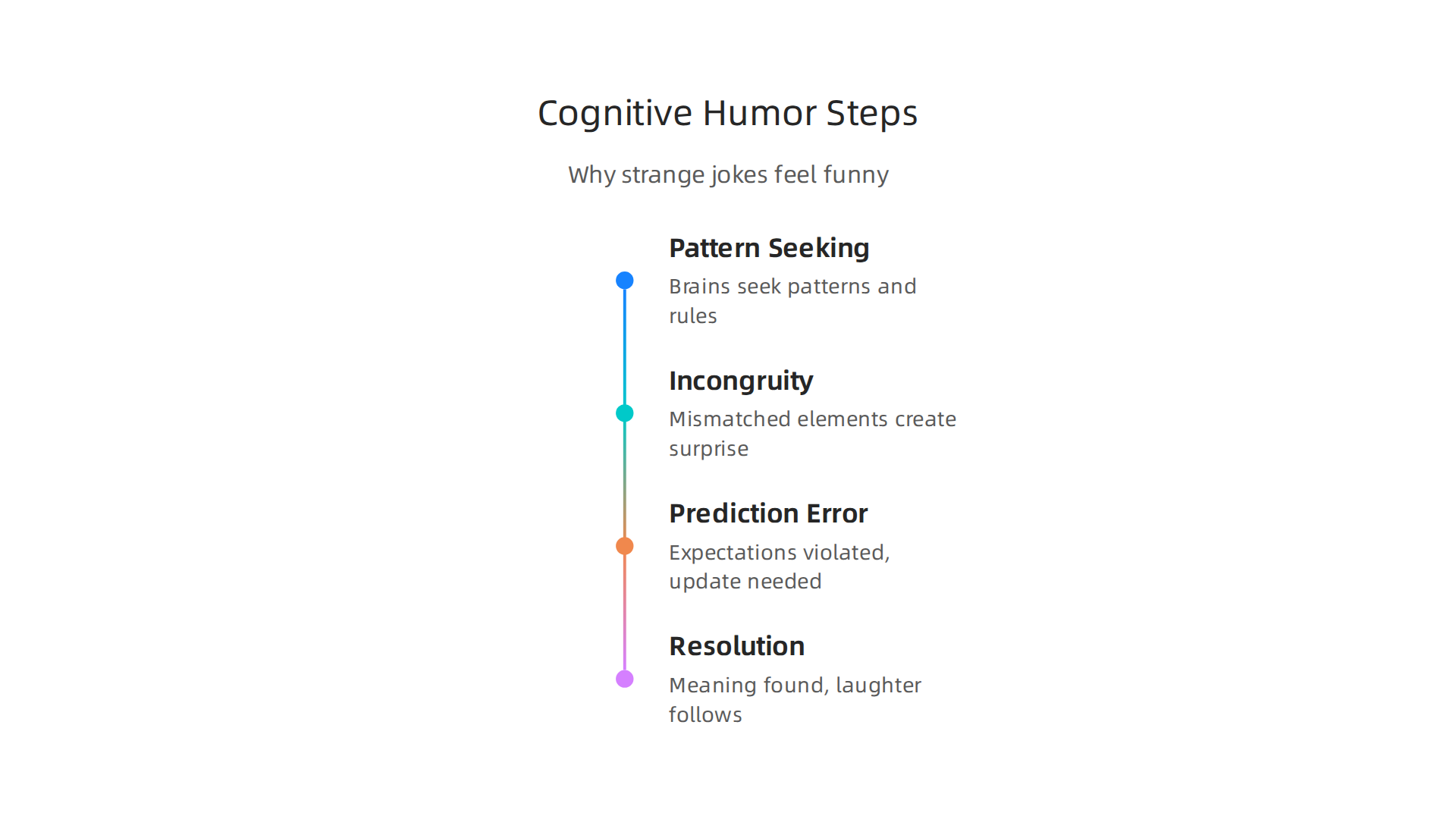
Our minds love patterns and order. We spend a lot of time trying to make sense of the world around us. So, when we see or hear something that doesn’t fit the expected pattern, our brain takes notice. This is a key part of why we find funny jokes for adults, especially absurd ones, so amusing.
One main idea is called incongruity. This just means that humor happens when two things that don’t belong together are put side by side, creating a mismatch HUMORCHAIN: Theory-Guided Multi-Stage Reasoning for …. Imagine a serious dog wearing a tiny hat and trying to order coffee. The idea of the dog being so human-like and the fancy hat just don’t go together, and that makes us laugh. It’s like seeing funny animals doing something totally out of character. Our brain spots the unexpected difference and finds it amusing.
Another big part of these psychological processes is prediction error and resolution. Our brains are always trying to guess what will happen next. When a joke delivers a surprise that breaks our guesses, it creates a "prediction error." But then, our brain quickly figures out why the surprise was funny or clever. This act of understanding the unexpected twist is called "resolution." When we solve this little puzzle in our heads, it feels good, and that good feeling often comes out as a laugh. This process rewards our brain for detecting and fixing these little errors Make it Funny! Developing a Novel Humor-Based Digital Positive ….
For adults, who have seen and learned so much, these strange jokes are especially satisfying. Our brains have more established patterns and expectations, so when a joke cleverly breaks those patterns, it’s a bigger, funnier surprise. Think about funny faces that are slightly off or unexpected; they catch us off guard because they don’t quite match our mental picture of a normal face. This pattern disruption helps us understand why absurd and surreal humor works so well for a mature audience. The emotional punch of a good laugh is deeply tied to these cognitive breakthroughs. To dive deeper into the feelings behind the laughs, you might want to explore Affect Theory Reveals Why Absurdist Humor Makes Us Laugh.
If you enjoy cosmic confusion turned into sharp, funny fiction, you might like to Start the Absurd Adventure.
Now that we understand the deep psychological processes behind why strange jokes feel funny to adults, let’s look at how clever writers actually put these ideas into practice. It’s one thing for our brains to enjoy a surprise; it’s another to craft that surprise on purpose. Writers use several smart tricks to create those perfectly timed moments of confusion and then resolution that make us laugh at funny jokes for adults.
Misdirection: The Art of the Surprise Turn
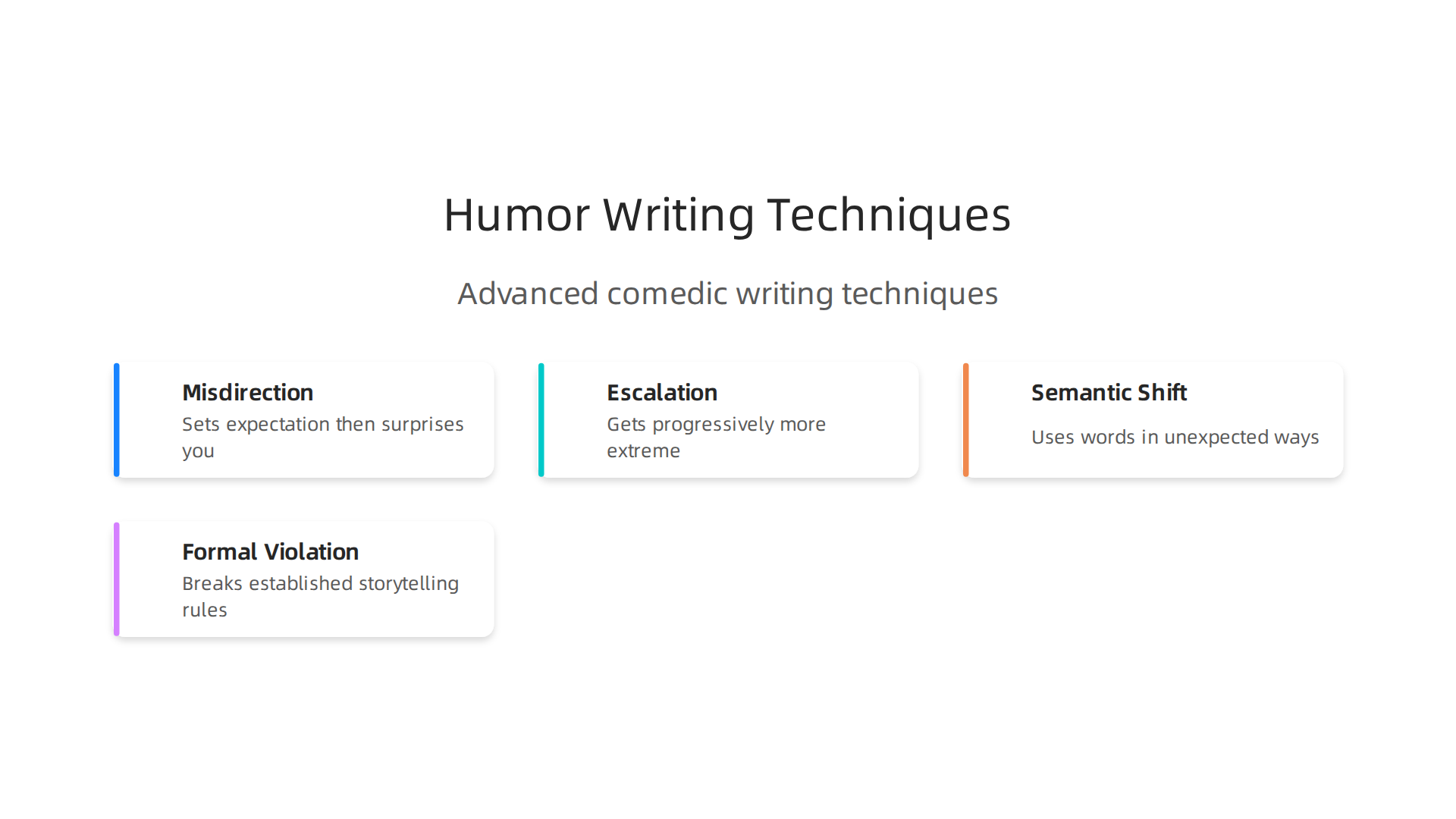
Misdirection is like a magic trick for your brain. The writer sets you up to expect one thing, then suddenly takes a sharp turn in a different direction. This creates that "prediction error" we talked about before, leading to a laugh when you realize the twist. It’s a key tool for creating funny jokes for adults that rely on smart surprises.
How to try it: Start a story or setup in a very normal, even serious way. Then, introduce an element that completely doesn’t fit or makes a sudden, absurd change.
- Micro-exercise: Write a sentence about a character getting ready for a big job interview. In the next sentence, have them find something completely illogical in their briefcase, like a talking potato.
Escalation: Making the Absurd Even More Absurd
Escalation means taking something a little odd and making it progressively crazier, one step at a time. It builds on the incongruity principle, where each new, strange detail makes the situation funnier because it keeps moving further from what’s normal. Think of a simple, odd event spiraling into total chaos.
How to try it: Pick a slightly unusual scenario. Then, brainstorm how you can make it ten times more unusual without losing the original idea.
- Micro-exercise: Imagine a squirrel trying to steal a single acorn from your yard. How could that situation escalate into something you’d expect in an action movie, but still be about the squirrel and the acorn?
Semantic Shift: Playing with Words and Meaning
Semantic shift is about using words or phrases in unexpected ways, changing their usual meaning to create humor. This often involves wordplay, puns, or taking common expressions literally in an absurd context. It’s a sophisticated technique that can make funny jokes for adults feel very clever. You can see how this works in many types of written comedy, from short gags to longer narratives. If you’re looking for unique ways to add humor to your writing, exploring how to write amusing extras can be really helpful, like when you learn how to write funny footnotes that make readers laugh.
How to try it: Take a common saying, idiom, or word. Think about its literal meaning, or another less common meaning, and apply it to a situation where it makes no sense, or too much sense.
- Micro-exercise: The phrase "bite the bullet." How could you make a scene literally about someone trying to bite a bullet, and what funny complications would arise?
Formal Violation: Breaking the Rules
Formal violation is when a writer breaks the established rules of storytelling, logic, or even how a text is supposed to work. This can mean characters who know they’re in a story, sudden changes in tone, or ignoring basic physics. It’s very effective for creating surreal, absurd humor because it shatters our expectations about how the world, or even the story itself, functions. For those interested in how far you can push these boundaries, there are many absurdist humor books that break every rule of storytelling.
How to try it: Start writing a normal scene, then suddenly introduce an element that breaks the fourth wall, defies gravity, or completely changes the genre without warning.
- Micro-exercise: Write a dialogue between two friends. Suddenly, have one character read aloud the stage directions for their actions, questioning why they’re doing them.
Crafting truly great comedy, especially the absurd kind, takes practice and a willingness to explore different creative avenues.

Many famous comedians and writers have shared their insights into the craft, offering tips from starting with a funny topic to understanding the whole comedy writing process. You can learn a lot from resources like "Jerry Seinfeld’s 5-Step Comedy Writing Process" on Writer’s Digest, which offers a clear guide to building jokes from scratch

Jerry Seinfeld’s 5-Step Comedy Writing Process. It’s also worth noting that what counts as funny can change, and writers often need to navigate what’s acceptable when pushing boundaries, as discussed in "COMEDY WRITING: Crossing the Line that Now Keeps Moving" COMEDY WRITING: Crossing the Line that Now Keeps Moving. If you’re serious about honing your comedic skills, there are even extensive masterclasses available, such as "A comedy writing masterclass from a writer of The Simpsons and Family Guy" which offers a deep dive into the craft A comedy writing masterclass from a writer of The Simpsons and Family Guy. You can also find many examples and explanations of these techniques in action by looking at absurdist funny videos explained with key techniques and examples.
If you’re ready to read a comedy where logic breaks and the universe gets weird, check out Absurdity, Meet Sci-Fi.
We’ve talked about the clever ways writers build humor using ideas like misdirection and playing with words. Now, let’s see these ideas in action with some real-world examples. Understanding these "close readings" helps us truly get why certain funny jokes for adults make us laugh, showing the psychological processes at play across different types of media.
The Classic One-Liner: A Peek at Misdirection
Think about a simple joke that twists your expectations. For example: "I told my wife she was drawing her eyebrows too high. She looked surprised."
Here, the humor comes from misdirection and a semantic shift. You expect "surprised" to mean shocked or startled. But the joke cleverly uses the literal meaning: her eyebrows were physically high up on her face, making her face look surprised. This sudden switch in meaning creates that moment of "prediction error" that makes the joke funny. It’s a perfect example of how a small twist can make a simple sentence one of those truly clever funny jokes for adults. The way our brains process this kind of unexpected resolution is a key part of how absurdist humor works, by making sense of what first seems like nonsense according to "Problem solved? Absurdist humour and incongruity-resolution".
Film: Escalation and Formal Violation
Absurdist humor often shines in film, where visuals and sounds can amplify the strangeness. Take a scene from a show like Monty Python’s Flying Circus, famous for its surreal humor. In the "Ministry of Silly Walks" sketch, a government official performs increasingly absurd ways of walking. Each new, exaggerated step escalates the situation, moving further and further from normal behavior. This showcases escalation in a big way.
But it also uses formal violation. The sketch takes a seemingly normal government department and applies it to something utterly ridiculous, breaking the expected rules of bureaucracy and reality. The serious tone combined with the silly actions creates a hilarious contrast. Movies and TV shows that play with logic like this are great examples of these techniques. If you like this kind of comedy, you might enjoy exploring absurdist comedy movies that defy logic from Chaplin to Rick and Morty.
Memes: Incongruity and the Absurd
In 2026, memes are a huge part of how we share funny jokes for adults online. Many memes use absurdist elements. Think about the "woman yelling at a cat" meme. It shows a dramatic, angry woman confronting a confused, innocent-looking cat. The humor here comes from the extreme incongruity: the over-the-top human emotion applied to a very calm, unimpressed animal. The situation is absurd, but it’s presented with genuine expressions, creating a funny image. Memes like this often go viral because they make us laugh at silly juxtapositions that reflect our own psychological processes. The widespread use of humor in meme marketing shows how effective these strange jokes can be, as explored in research about The Impact of Humour in Meme Marketing on Consumer Engagement Among Young Consumers Evidence from Bengaluru, India.
These examples show how misdirection, escalation, semantic shifts, and formal violations aren’t just ideas; they’re the building blocks of humor all around us. They highlight that the philosophical idea of absurdism is really about finding humor in the contradictions of life itself, turning serious thoughts into funny ones as discussed in "What is Absurdism? | Definition, Examples & Analysis".
Love Absurd Humor? Meet the sci-fi series built around strange logic and smarter laughs.
We’ve just seen how classic ideas like misdirection and escalation make funny jokes for adults work. Now, let’s turn those ideas into action! If you want to create your own strange and clever humor, here are some steps to get you started.
Start with the Strange: Developing Absurd Premises
To write funny jokes for adults that use absurdism, you need to begin with an absurd idea. This means taking something normal and twisting it in a really unexpected way.
- Brainstorm Unusual Pairings: Think of two things that don’t belong together at all. Like a serious business meeting held by a group of funny animals, or a deep philosophical discussion happening between two funny faces. The clash itself can be a starting point.
- Ask "What If?": This is a great trick. What if gravity only worked on Tuesdays? What if everyone suddenly started speaking in rhymes, even when sad? These "what if" questions open the door to absurd scenarios.
- Exaggerate Normal Situations: Take an everyday event, like waiting in line, and push it to an extreme. Imagine the line is miles long, moves backwards, or is guarded by a tiny, strict squirrel. Making things bigger or weirder than they should be is a key part of absurdist humor.
Crafting the Punch: Timing and Delivery
Once you have an absurd premise, how you tell the joke matters a lot. Timing is everything in making funny jokes for adults land well.
- Pacing of Words: A slow build-up to a sudden, silly reveal can be very effective. Or a quick, sharp line can surprise people. Think about the rhythm of your words.
- The "Surprise" Element: Absurdist humor often works because it creates a "prediction error" in our minds. We expect one thing, and the joke gives us another. This unexpected twist is what makes us laugh, touching on those complex psychological processes of humor resolution. Research into how the brain processes humor has shown that understanding the unexpected is key to how we find jokes funny, as detailed in an overview of The psychology of humor : an integrative approach.
- Refining Your Comedic Voice: How do you sound when you tell a joke? Are you deadpan, excited, confused? Your unique voice makes your jokes special. Keep practicing and trying out different ways to say things until it feels right. Even famous comedians like Jerry Seinfeld have a structured process for writing comedy, starting with a funny topic and exploring emotions around it, according to Jerry Seinfeld’s 5-Step Comedy Writing Process.
If you want to dive deeper into writing clever and unexpected lines, you might enjoy learning how to write funny footnotes that make readers laugh.
Getting Better: Workshop and Testing
Writing is just the first step. To really make your adult absurd jokes shine, you need feedback and practice.
- Feedback is Your Friend: Share your jokes with trusted friends or a writing group. Ask them what they found funny, what was confusing, and what didn’t quite work. Listen to their honest thoughts.
- Test Your Jokes with Audiences: Even if it’s just a small group, try telling your jokes out loud. See where people laugh, where they don’t, and if they understand the weirdness. This helps you fix parts that are unclear or too long.
- Being Mindful: Ethical Lines in Comedy: While absurdist humor can push boundaries, it’s also important to think about who your joke is for and if it might truly hurt or offend. The goal is to make people laugh, not cause pain. There’s a balance between being edgy and being unkind. Thinking about these lines is part of becoming a good humor writer.
Ready to explore a world where logic takes a vacation and the universe gets weird?
Start the Absurd Adventure with a book that turns cosmic confusion into sharp, funny fiction. Start the Absurd Adventure.
Summary
This article explains why everyday jokes and adult-targeted absurd humor deserve serious philosophical and psychological attention. It defines everyday, absurdist, and surreal humor, then links those styles to core theories like incongruity and prediction-error/resolution to show how our brains process funny surprises. The piece outlines the aesthetic and rhetorical roles absurdity plays, describes cognitive mechanics that make strange jokes satisfying for adults, and explains how culture shapes what lands as funny. It also gives practical writing techniques—misdirection, escalation, semantic shift, and formal violation—plus exercises, delivery tips, and guidance on testing material responsibly. Readers will finish able to recognize why certain jokes work, create their own absurd premises, and test and refine comedic lines for different audiences.