Introduction: The Unexpected Punchline in the Margins
You’re reading along in a funny fiction book, and your eye catches a tiny superscript number. You glance down, expecting a dry source or a boring clarification. But instead, you find a hidden joke.

A silly aside. Maybe even a whole mini-story that makes absolutely no sense. That’s the magic of a funny footnote.
Actually, a footnote can be more than a citation. It can be a comedic trap. When done well, it pulls you out of the main story just long enough to deliver an unexpected punchline. Think of authors like David Foster Wallace, who turned footnotes into their own playground, or Laurence Sterne, whose 1759 novel The Life and Opinions of Tristram Shandy, Gentleman used digressions and footnotes to mock the very idea of a straightforward narrative. The history of experimental literature shows us that these techniques have been around longer than you might expect.
Here’s the thing though. Many readers of absurdist humor miss the craft behind these well-placed notes. They laugh without knowing why. They enjoy the strange twist but don’t see the mechanics at work. That’s a shame, because funny footnotes are one of the most clever tools in a writer’s toolkit. And footnotes can be used to comment on a narrative or to create a new one entirely.
So in 2026, while more writers than ever are experimenting with humorous books and nonsense fiction, this guide will unpack the mechanics, history, and practical techniques for writing funny footnotes. You’ll learn where they came from, how masters like Sterne and Wallace used them, and how you can start adding your own witty asides to your work. For more on the broader framework behind absurdist techniques, check out our deep dive into absurdist comedy movies that defy logic.
If you’re ready to turn the margins of your writing into a comedy stage, keep reading. And if you want to see how one series runs wild with strange logic and sharp laughs, visit The Ridiculous to meet a universe built around smarter, weirder storytelling.
What Makes a Footnote Funny? The Mechanics of Absurdist Disruption
So you’ve seen the weird spark of a funny footnote. But what actually makes it work? It’s not just random silliness. There’s a real psychological engine behind it.
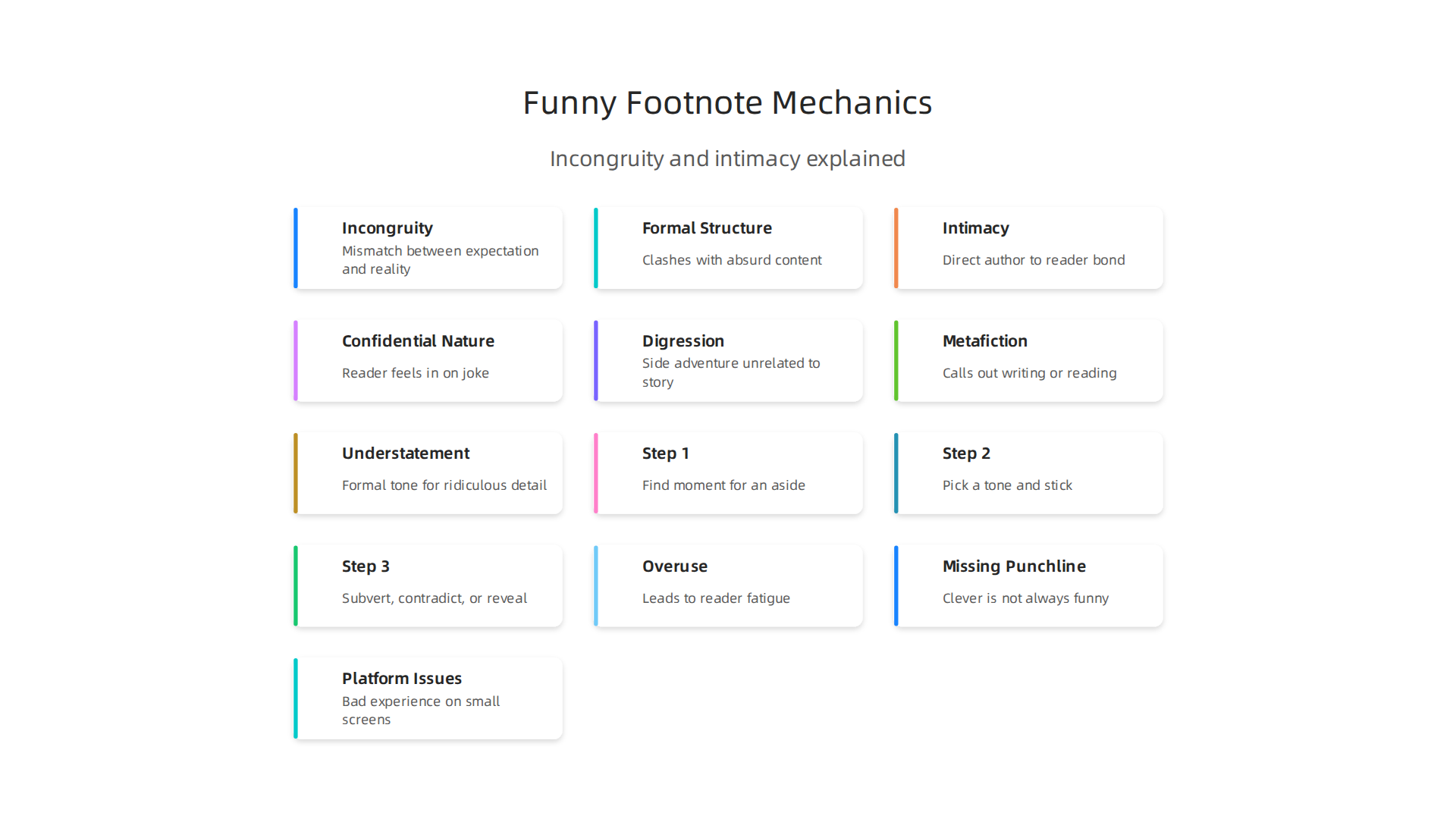
The main driver is something psychologists call the Incongruity Theory. In simple terms, humor pops up when there’s a mismatch between what we expect and what happens. Research confirms that humor is derived from the resolution of these incongruities. Your brain sets up a pattern, and when that pattern breaks in a clever way, you laugh.
Now apply this to a footnote. When you see a superscript number in a book, your brain expects a dry citation or a boring clarification. You shift into "information processing" mode. But instead of a source, you get a wild aside about a weird hobby or a silly made-up word. This is exactly where the Incongruity Theory shows its real power. The frame of the "academic footnote" clashes hard with the "absurd content."
This is the same mechanic used in deadpan comedy. An actor delivers a ridiculous line with a perfectly straight face. That mask of seriousness makes the joke hit much harder. The footnote acts as that straight face. The more official and formal it looks, the funnier the joke inside it becomes. This technique appears in many humorous books where the main narrative voice is already playful and the footnotes double down on that personality.
But there’s a second part to this trick. The footnote creates an intimate aside. It’s a direct line from the author to you, the reader. It cuts out the main story for a second and says, "Hey, just between us…" This shift in power is huge. Instead of just following the plot, you become a confidante. You’re in on the joke.
So the mechanics of a funny footnote are a one-two punch. First, the incongruity between the formal footnote structure and the silly content creates surprise and laughter. Second, the intimate, confidential nature of the aside creates a real bond with the reader.
Want to see how this kind of sharp, intimate absurdity plays out across a whole series? Read Book 1 of The Ridiculous and experience narrative disruption turned into an art form.
A Brief History of the Funny Footnote: From Sterne to Infinite Jest
Now that you understand why a fake footnote can make you laugh, let’s look at where this strange superpower came from. The funny footnote is not a new trick. Writers have been using it for centuries to break rules and surprise readers.
The 18th-Century Pioneer
The real godfather of the funny footnote is Laurence Sterne. His novel The Life and Opinions of Tristram Shandy, Gentleman came out in 1759. It is one of the first books to use footnotes as a playground for humor. According to this history of experimental literature, Sterne loved to mock the idea of telling a straight story. He filled his pages with digressions, silly diagrams, and yes, footnotes that went totally off track. The book is still known for its "boundlessly imaginative and unmatched absurd and timeless wit," as Goodreads puts it. Sterne showed that a footnote could be a place for the author to joke directly with you.
The Modern Master of the Footnote
Fast forward to the late 20th century. David Foster Wallace took the funny footnote to a whole new level. His novel Infinite Jest is famous for having hundreds of footnotes. Some of them are longer than the main story. Wallace used the footnote as a secret tunnel. He would interrupt the plot to explain a strange fact, tell a joke, or create a second story running underneath the first. As his Wikipedia page notes, he was a master of encyclopedic fiction. This style, called the "encyclopedic novel," uses footnotes to pack in huge amounts of information, jokes, and commentary. It turns the act of reading into a playful game.
A Global Tradition
This idea of using footnotes for humor is not just an English or American thing. Writers in Japan have used marginal notes in metafiction to break the fourth wall. In Latin America, authors have employed absurdist marginalia to add layers of meaning and comedy. The footnote, in its many forms, has always been a tool for the writer to speak directly to the reader, outside the main story.
From Sterne’s 18th-century trick to Wallace’s massive modern puzzles, the funny footnote has proven its staying power. And in 2026, it lives on in innovative, absurdist fiction. Want to see how this sharp, intimate style of humor works in a new series? Check out the kind of narrative disruption found in absurdist comedy books that break all the old rules.
Read Book 1 of The Ridiculous and see the footnote turned into its own comic art form.
Key Techniques: Digression, Metafiction, and Understatement
Now that you know the history behind funny footnotes, let’s get into the three main tricks writers use to make them work. These techniques are the secret sauce.
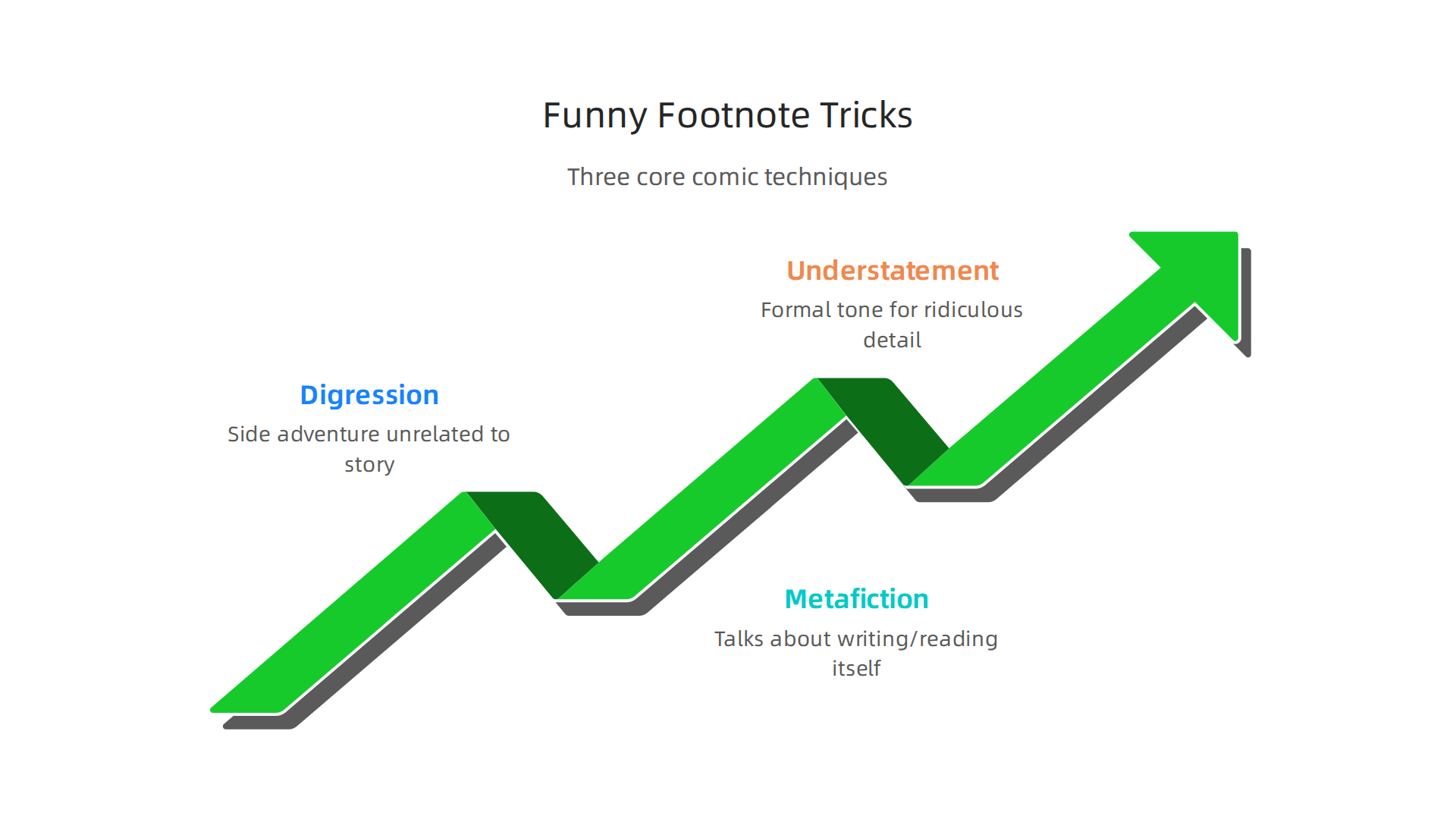
Once you spot them, you will see them everywhere in humorous books and funny fiction books.
Digressive Footnotes That Wander Off
The first technique is digression. The writer drops a footnote that has almost nothing to do with the main story. It is a little side adventure. For example, the main text might say "He walked into the room." The footnote then dives into a three paragraph rant about why that specific door handle is poorly designed. This kind of footnote works because it breaks the rhythm.
Scholar Gérard Genette called footnotes a form of "paratext," which is everything around the main text that helps shape how you read it. As one study on footnotes in fiction explains, these side notes create a "second layer of storytelling." The joke is that the footnote is more interesting than the actual plot. You can see this kind of narrative disruption in modern absurdist comedy movies that defy logic, where the story keeps veering off into weird places.
Metafictional Footnotes That Break the Fourth Wall
The second technique is metafiction. This is when the footnote talks about the act of writing or reading itself. The author steps out from behind the curtain and says something like, "Dear reader, I know this paragraph is boring. I am sorry. Here is a funny cat fact to make up for it."
This technique is powerful because it makes you feel like you are sharing a secret with the writer. According to research on paratextuality, these little interruptions can change how you feel about the whole story. They make the fiction feel less like a finished product and more like a conversation. It turns a book into a playful game. If you enjoy this kind of trick, you might also like reading about other absurdist humor techniques in other media.
Understatement and the Deadpan Joke
The third technique is understatement. This is where the formal, serious tone of a real footnote meets something completely ridiculous. The writer uses the same stiff academic language to explain a trivial detail, like the exact color of a character’s socks. The humor comes from the clash.
One academic paper on artificial paratexts notes that footnotes in fiction often "emphasize the fiction of the text" by treating fake details as if they are facts. The deadpan delivery is key. The writer never winks at you. They just deliver the absurd information in the most boring, official way possible. That is what makes it so funny.
So there you have it. Digression, metafiction, and understatement. These are the three pillars of the funny footnote. Want to see how a whole series uses these techniques from start to finish?
Visit Ridiculous and explore a universe built around sharp, strange, and footnoted fiction.
The Role of the Reader: Co‑creation and Interpretive Play
So far we have looked at what writers do. But here is the truth. A funny footnote only works if you, the reader, play along. You are not just a passive audience member. You are an active partner in the joke.

Think about it. Every time you see that little superscript number, your eyes have to leave the main text and jump down to the bottom of the page. Then you have to process the new information and jump back up. That physical and mental hop is a small effort. But it makes you feel like you are in on the secret. You are not just reading the story. You are helping build it.
This idea of co-creation is central to how funny footnotes work. As a study on footnotes in fiction explains, these side notes create a "second layer of storytelling" that the reader must navigate. You become a kind of detective, deciding which rabbit holes to follow and which to skip. That choice makes the reading experience feel personal and interactive.
The Footnote as a Secret Easter Egg
Here is another way to think about it. A footnote can act like a hidden Easter egg in a video game. If you just read the main story, you get the basic plot. But if you take the time to look down at the note, you get a bonus joke or a weird fact that the rest of the world misses.
This is where funny names or silly asides become even funnier. The writer hides them in the footnote, almost as if they are whispering a secret to you. You become part of a tiny club. That shared secret feeling is a big reason why humorous books that use footnotes feel so rewarding. They make you work for the laugh, which makes the laugh land harder.
When the Joke Falls Flat
But the co-creation cuts both ways. If you choose to skip the footnotes, you lose the punchline. The whole trick depends on your willingness to engage with the paratext, the space around the main story.
And here is the tricky part. If you take the footnote too seriously, the humor can also fall apart. A footnote written in deadpan academic language is only funny because you recognize the absurd gap between the serious tone and the silly content. If you miss that gap, the joke does not land. Psychologists call this the "incongruity theory" of humor. The humor comes from the clash between what you expect and what you get.
This is why funny fiction books that use footnotes well are so clever. They trust you to get the joke. They treat you like a smart reader who can handle a little cognitive work for a bigger payoff.
Want to put this co-creation idea to the test? Try a series that makes footnotes a central part of the reading experience.
Read Book 1 and see how the reader’s choices shape the story.
Funny Footnotes in the Digital Age: Memes, Hyperlinks, and Marginalia
The co-creation we talked about did not stay in books. It moved online. In 2026, funny footnotes are everywhere. You just might not call them that anymore.
Think about Reddit comments. Someone writes a long post and then adds a little note like "edit: thanks for the gold" or a weird aside in parentheses. That is a footnote. On Twitter, people add threaded replies with punchlines that only work if you read the whole chain. That is also a footnote. And memes? Many popular formats use a top text as the main setup and a bottom text or comment section as the punchline. The structure is the same. You have to look at the whole thing to get the joke. This is how absurdist funny videos work too. The humor lives in the gap between the main action and the small detail you almost missed.
Hypertext Fiction and Clickable Secrets
Then there is hypertext fiction. This is web literature where you click on links inside the story to move forward or to uncover hidden jokes. Each click is like turning to a footnote. You choose which path to follow. Writers build entire stories around this idea. They hide the best punchlines in the branches you have to actively explore. It is interactive storytelling at its most playful.
The Return of Marginalia
Here is something surprising. The old habit of scribbling in the margins of books is making a comeback. But now it is digital. Platforms like Hypothesis let you highlight any webpage and add a public note. You can see what other readers thought about the same line. It is like everyone gets to write their own footnotes on the same page.
Edutopia explains that these social annotation tools turn passive reading into active conversation. You become part of a community of curious minds. And since creative ways to annotate digital texts keep growing, this trend is not slowing down.
What does this mean for you? It means the old footnote is alive and well. It just wears different clothes now. The idea is the same. A hidden layer of meaning that rewards you for paying attention.
If you like this kind of playful reading, you will love a series that treats the whole universe like one big footnote.
Explore the Series and see how far the joke can go.
How to Write Your Own Funny Footnotes: A Practical Workshop
You have seen how funny footnotes work in the wild. Now you want to create them yourself. The good news is you do not need to be a professional comedian. You just need to follow a few simple steps. Think of this as a workshop where you get to play with words.
Let us start with a simple exercise. Write a short letter to a friend about a boring day at work. Now add a footnote that reveals something silly.

For example, your main text says "I had a three hour meeting about paper clips." Your footnote says "I counted 47 of them on the table. The green ones look angry." See how that works? The footnote adds a layer of personality that the main text hides.
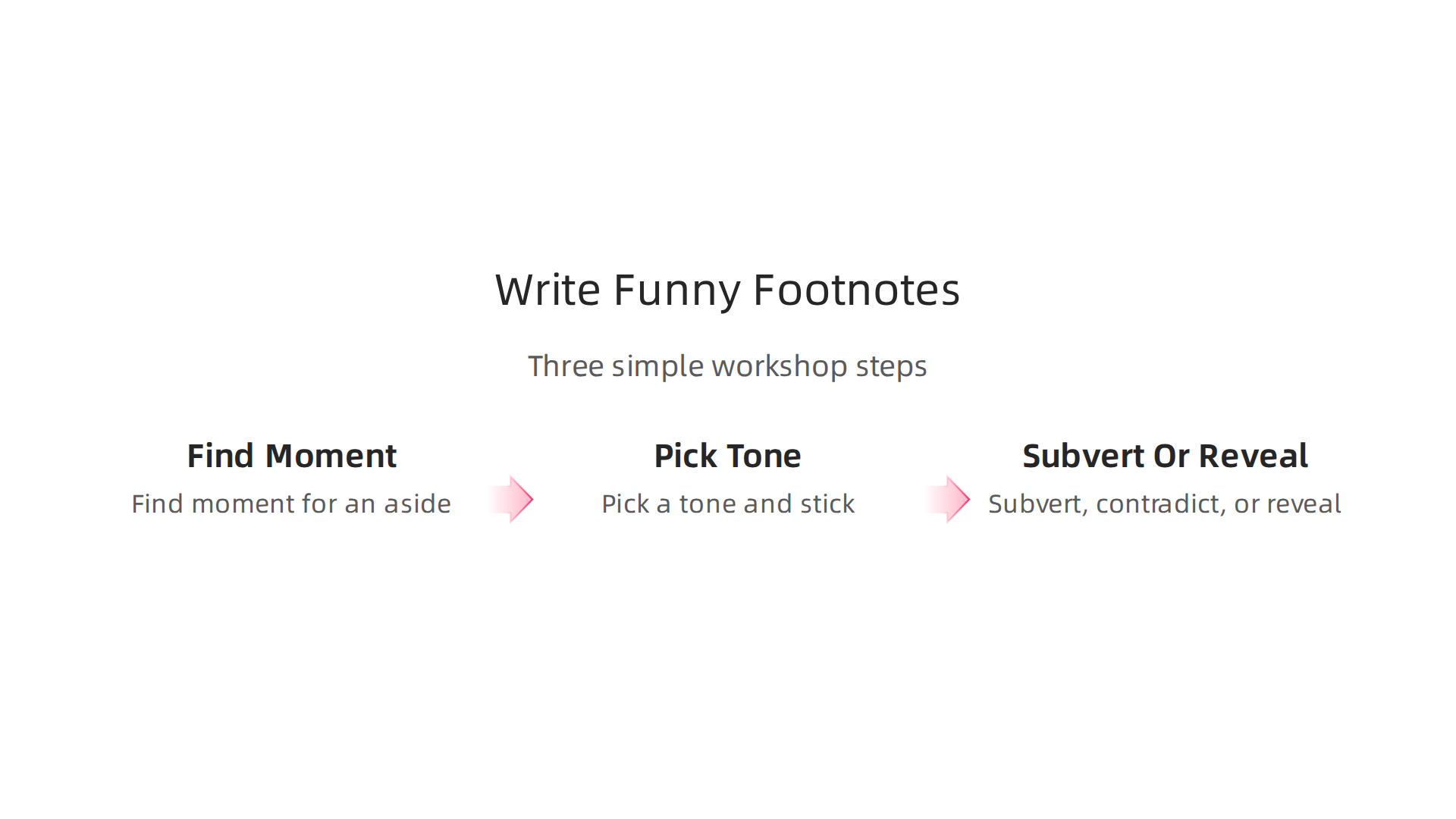
Step 1: Find the Moment That Begs for an Aside
The best footnotes come from moments when your main story needs a break. Look for places where you want to whisper something to the reader. Maybe you are describing a character and you want to admit they are secretly weird. Or maybe you are listing facts and one of them is so strange it needs a comment.
Scott Dikkers, the founder of The Onion, says the more astute and original your opinion on a topic, the better your humor writing will be. So trust your weirdest observations. That small detail you almost ignored? That is your footnote gold.
Step 2: Pick a Tone and Stick With It
You have three main choices for your footnote voice:
- Academic: Use dry, formal language to describe something completely ridiculous. The contrast makes it funny.
- Deadpan: State the absurd fact as if it is perfectly normal. No jokes, just serious delivery.
- Manic: Let your excitement or frustration spill over. Use short sentences, exclamation points, and wild tangents.
Commit to one tone for each footnote. Switching between them mid note confuses the reader. Jerry Seinfeld talks about the importance of structure and timing in comedy. Treat your footnote like a tiny comedy routine with a clear voice.
Step 3: Use the Footnote to Subvert, Contradict, or Reveal
This is where the magic happens. A great footnote does one of three things:
- It subverts a claim by adding a twist. "The plan was flawless. (The plan was not flawless. We forgot the batteries.)"
- It contradicts a fact with a new truth. "The movie was a critical success. (My cat walked out after ten minutes. That counts.)"
- It reveals the author’s true opinion hiding behind polite language. "I was happy for his promotion. (I am still happy. I just wish my office had a window.)"
You can also use funny names in your footnotes to add character. Give the imaginary source a goofy name like Professor Blorbo. It turns a simple reference into a running joke.
If you want to see how professional writers pull this off, check out some absurdist comedy movies that defy logic. They use the same techniques but on a bigger scale.
Now it is your turn. Grab a piece of writing you already have. Add one footnote to each paragraph. See which ones make you smile. The more you practice, the more natural it feels.
Still hungry for more examples? The Ridiculous series is built around this exact idea of hidden layers and surprising asides. It is a whole universe of footnotes waiting to be explored.
Read Book 1 and see how far one funny footnote can go.
Avoiding Pitfalls: When Footnotes Stop Being Funny
By now you are probably excited to add funny footnotes everywhere. And that is great. But let us talk about the traps that can turn your clever asides into reader annoyances.
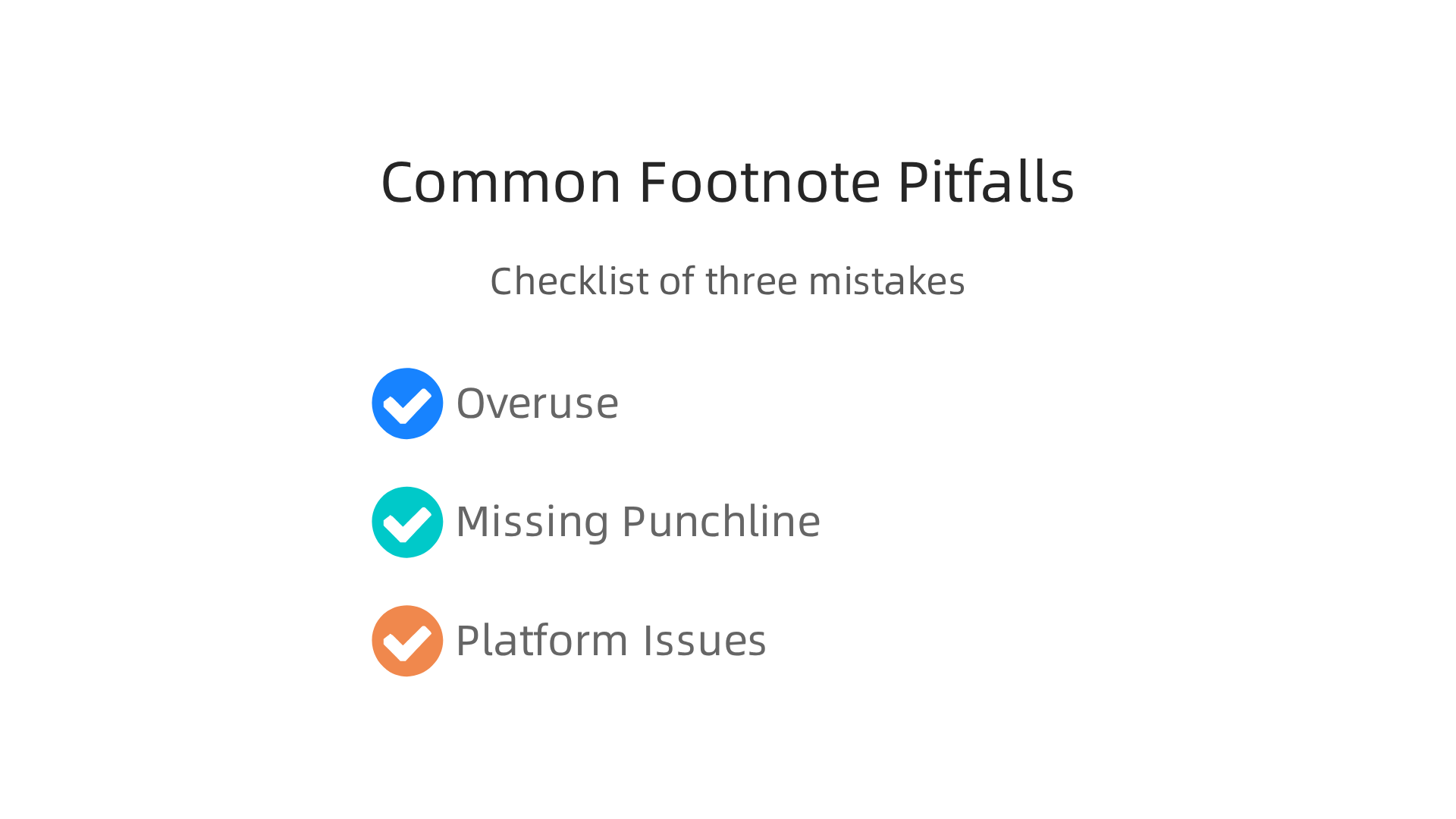
Overuse: The Footnote Fatigue Trap
The biggest mistake is using too many footnotes. When every other sentence has a little number dangling at the end, the magic wears off fast. The reader stops feeling like they are in on a secret joke. They start feeling exhausted.
Think of it like this. If a comedian told a joke between every single word, you would not laugh. You would leave. The same applies here. Footnoting is a technique of surprise. And you cannot surprise someone if you never stop doing it.
Some legal writing guides have debated whether a 2:1 ratio of footnotes to text is excessive. That context is about academic writing, but the lesson applies to humor too. If your main text is mostly serving as a bridge between footnotes, you have lost the plot.
Missing the Punchline: Clever Is Not Funny
Here is a painful truth. A footnote can be intellectually clever without being funny. You might craft a perfectly structured aside that points out a logical contradiction. And the reader nods and thinks "that is smart." But they do not laugh.
The difference is emotion. Funny footnotes need a spark of personality. They need a silly detail, a human reaction, or a ridiculous image. As Pat Thomson notes, footnotes can sometimes feel pretentious if they are just showing off. Keep asking yourself: does this footnote make me smile? If not, cut it.
Platform Issues: Footnotes on Small Screens
This is a modern problem. In 2026, a huge chunk of reading happens on phones and e-readers. And footnotes on those devices can be a mess.
On a tiny screen, a footnote number can look like a typo. Or worse, the reader taps it and gets thrown to the end of the chapter. They lose their place. They have to scroll back up. That is not a fun experience. That is a broken one.
If you are publishing online or as an e-book, test your footnotes on an actual phone. Make sure the reading experience stays smooth. If the platform makes footnotes painful, consider using parenthetical asides instead.
The Bottom Line
Funny footnotes are a tool, not a rule. Use them sparingly. Make sure they are actually funny, not just clever. And always think about how they will read on a small screen.
If you want to see how professional absurdist writers balance digressions with main narrative flow, check out how absurdist comedy movies that defy logic handle the same challenge on a bigger stage.
When you get it right, a single well-placed footnote can make a reader laugh out loud alone in a coffee shop. That is the goal. Quality over quantity. Always.
Ready to see a masterclass in funny footnotes done right? Read Book 1 of The Ridiculous series and watch how one absurd aside builds an entire universe.
Summary
This article explains how footnotes can do more than cite sources — they can be comedic devices that disrupt a narrative and create an intimate joke between author and reader. It covers the psychological basis (incongruity theory), a brief history from Laurence Sterne to David Foster Wallace, and three practical techniques — digression, metafiction, and understatement — that writers use to make marginal asides land. The guide also describes the reader’s role in co‑creating the humor, gives a short workshop with steps and tone choices for crafting your own footnotes, and warns about common pitfalls like overuse and poor mobile experience. Throughout, it shows how the form lives on in digital media and offers concrete exercises so you can add funny footnotes to your fiction without ruining pacing or clarity. After reading, you’ll understand why footnotes work, when to use them, and how to write ones that actually make people laugh.