

Introduction: Why Gwyneth Paltrow’s Filmography is a Goldmine for Absurdist Humor
When you look at the full list of Gwyneth Paltrow movies, you might notice a funny pattern. She can go from a dark thriller like Seven to a sweet period drama like Emma without skipping a beat. But the real surprise comes when you see her in broad, silly comedies like Shallow Hal or quirky Wes Anderson films.

Her full career, cataloged on Rotten Tomatoes, shows this incredible range. This unexpected mix makes her filmography a perfect place to study absurdist humor.
She often plays her roles completely straight. This deadpan delivery makes the surreal situations around her stand out even more. It is a classic trick used by many actors we have covered, like in our look at movies with Tessa Thompson where absurdist humor feels strangely real. Gwyneth Paltrow does the same thing. She acts totally normal while the world around her gets weird. That contrast is pure comedic gold.
In this article, we will explore her career as a case study. We will look at how her work with different directors helped shape a unique style of comedy. Her early performances on Wikipedia include heavy dramas and light comedies. We will see how she used her serious style to make absurd jokes even funnier. By the end, you will see her filmography in a whole new light. You might even discover your new favorite surreal comedy.
The Unlikely Intersection: Gwyneth Paltrow and Absurdist Humor
To understand how Gwyneth Paltrow became an accidental queen of absurdist humor, you have to look at where she started. Her early work in the late 1990s built her reputation as a serious dramatic actress. Movies like Emma (1996) and Shakespeare in Love (1998) earned her awards and critical praise. But even in these period pieces, there is a strange undercurrent.
Take Emma. The movie is a romantic comedy set in 1800s England. But the entire plot depends on Emma’s wild misunderstandings and overconfidence. She tries to control everyone’s love life and fails hilariously. That setup is basically a farce in fancy dresses. The absurdity comes from how seriously she takes her terrible matchmaking. Paltrow plays Emma completely straight. She never winks at the camera. That deadpan attitude makes the ridiculous situations even funnier.
The same thing happens in Shakespeare in Love. It mixes real history with a made-up love story. The anachronisms and over-the-top theater scenes are silly. But Paltrow’s character, Viola, always feels grounded. She treats her romantic drama with total sincerity. That contrast between a serious performance and a silly world is pure absurdist comedy.
Then Paltrow made a sharp turn into broad mainstream comedies. In 1998, she appeared in There’s Something About Mary. The movie is full of crude, over-the-top gags. Paltrow plays a small role, but she fits in perfectly because she treats the craziness as normal. A few years later, she starred in Shallow Hal (2001). That movie asks you to accept a man who sees people differently because of hypnosis. It is a wild concept, but Paltrow plays her character with warmth and sincerity. She never makes fun of the premise. She fully commits.
This pattern is exactly what makes actors like Keanu Reeves so good at deadpan comedy. If you are curious about that style, check out our breakdown of Keanu Reeves’ absurdist humor and the secret behind his deadpan comedy genius. Paltrow uses the same trick.
By mapping her career, you can see she did not abandon her dramatic roots. She simply applied her serious acting style to increasingly silly stories. That is the foundation of her absurdist appeal.
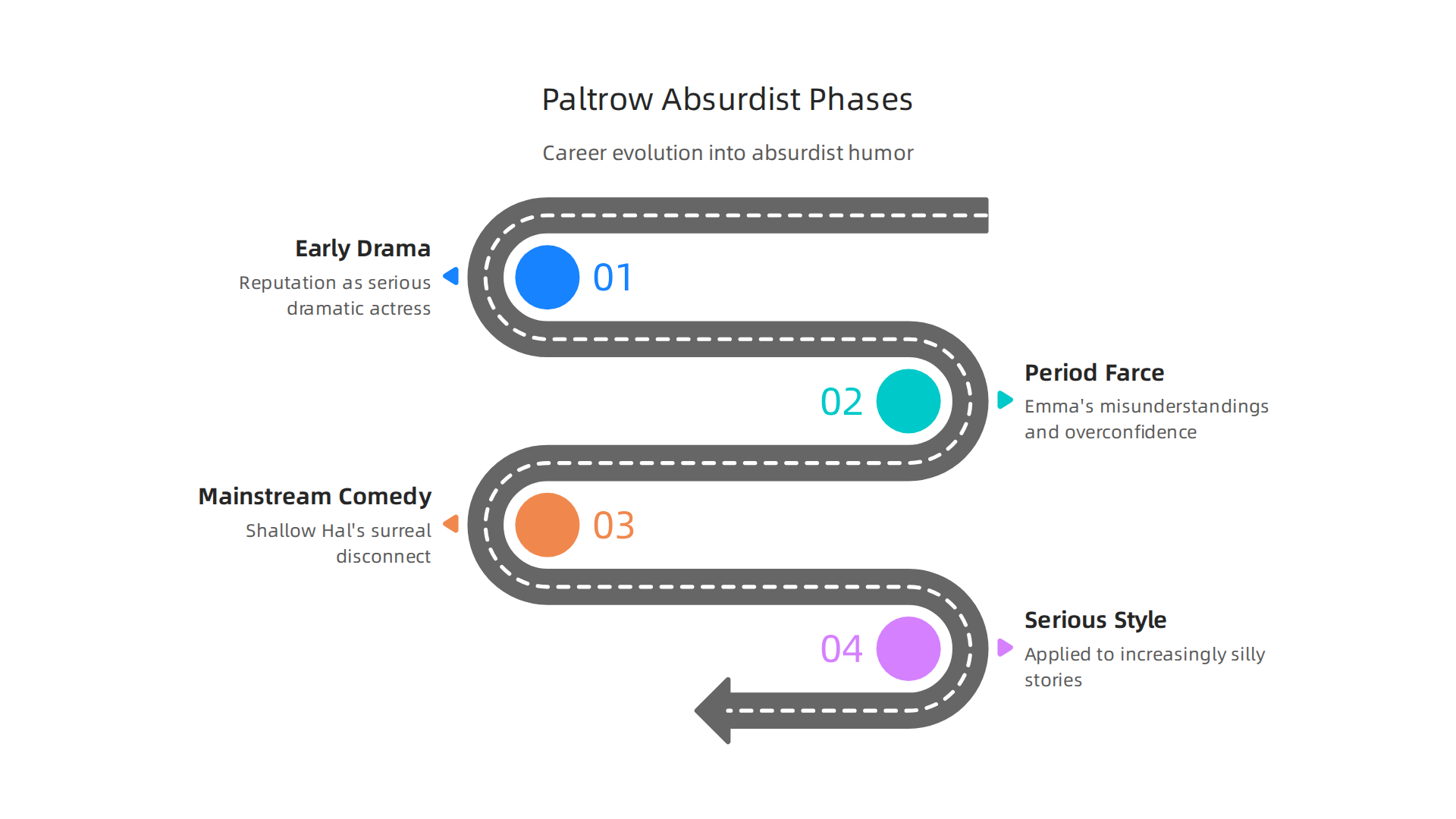
According to her full filmography on Rotten Tomatoes, she kept mixing heavy dramas like Proof (2005) with comedies like Shallow Hal. That shift from prestige period pieces to broad farce is what sets the stage for a deeper look at her comedic evolution.
Early Career: Establishing Range
Before she ever made a broad comedy like Shallow Hal, Paltrow was already picking roles with a strange, ironic edge. Some of her earliest big movies set the stage for everything that came later.
You can trace this back to Se7en (1995). That movie is a grim crime thriller. But the whole story is built on a serial killer who uses the seven deadly sins as a twisted framework. That premise is darkly absurd. The killer treats his grotesque acts as a moral lesson. Paltrow plays a supporting role, but she is the heart of the movie. Her character brings warmth into a world so bleak that it almost feels like a parody of despair. According to her full filmography on Rotten Tomatoes, Se7en was one of her earliest credited roles. It shows she was ready to take absurd situations seriously from the start.
Then came The Talented Mr. Ripley (1999). That film is a psychological thriller full of identity swaps, lies, and murder. The whole premise is ironic. A man kills a rich friend and then pretends to be him. Paltrow plays a socialite who slowly realizes something is off. The movie treats its twists with total seriousness, which makes the absurdity of the situation hit harder. Her deadpan confusion in key scenes is almost comedic.
The most direct link to absurdist humor comes from Sliding Doors (1998). That movie has a completely surreal premise. It shows two parallel timelines based on whether Paltrow’s character catches a train. One life works out well. The other falls apart. That setup is straight out of philosophical absurdism, which often plays with fate, randomness, and meaning. As her Wikipedia page notes, the film was one of her key early projects. And it proves that her comedic instincts were alive long before she started breaking into outright comedies.
If you enjoy this kind of surreal storytelling in film, check out our list of absurdist comedy movies that defy logic from Chaplin to Rick and Morty. It breaks down how other films use these same techniques. For Paltrow, these early roles were just the warm-up act for her full absurdist evolution.
Mainstream Absurdity: Farrelly Brothers and Beyond
By the early 2000s, Gwyneth Paltrow had proven she could handle dark, ironic premises. But then she took a hard left turn into full blown mainstream absurdity. She joined forces with the Farrelly Brothers, the kings of gross out comedy. And that is where her unique talent really shined.
Let us start with Shallow Hal (2001). The premise is pure absurdist fantasy. A man is hypnotized to see only a person’s inner beauty. So a conventionally unattractive woman literally looks like Gwyneth Paltrow to him. The whole movie hinges on that surreal disconnect. It uses gross out humor to explore a genuinely sweet idea. According to trends in the comedy film market, diverse storytelling like this was starting to reshape the genre. Paltrow had to play both the idealized vision and the real woman behind it. That takes real skill.
Then came There’s Something About Mary (1998). This movie is a masterclass in controlled chaos. Paltrow plays a small but memorable role as a grounded, normal person surrounded by absolute lunatics. She does not get the big slapstick moments. Instead, her straight faced reactions make every crazy thing happening around her even funnier. That is the secret to her absurdist power.
These two movies highlight a key tension. Paltrow can play realism perfectly, which makes the surreal elements around her pop even more. She is the calm eye of the hurricane. Much like how Keanu Reeves uses deadpan delivery for absurdist effect, Paltrow uses her grounded presence to sell the insanity. It is a rare skill, and it made her one of the most fascinating actors working in comedy during that era.
Genre-Bending: Thrillers, Dramas, and Comedies with Absurdist Undercurrents
You might think Paltrow peaked with gross-out comedies. But here’s the thing: her best work often happens when she slides into a serious genre and brings a little absurdity along for the ride. Her filmography refuses to be pinned down. She moves between thrillers, dramas, and comedies, and in each one, you can spot those same surreal, irrational threads. That is what makes her so interesting to study if you want to blend absurdist humor across genres.
Take The Royal Tenenbaums (2001). Wes Anderson’s film is a comedy, a drama, and a tragedy all at once. It is also soaked in absurdist irony. Wikipedia calls it "absurdist and ironic" throughout. Paltrow plays Margot Tenenbaum, a withdrawn, chain-smoking adopted daughter who wears a fur coat and a deadpan mask. She never goes for big laughs. Instead, her quiet, melancholic presence makes the family’s weirdness feel even stranger. One review described the movie as "full of broken people struggling through life" that "somehow makes me smile." That is the absurdist magic: taking real pain and presenting it with a straight face.
Creators who want to blend absurdist humor across genres can learn a lot from this.

Paltrow does not force comedy into a drama. She lets the absurd world do the work, and she stays grounded. The result feels honest and surreal at the same time. If you want to see more examples of films that mix genres like this, check out our breakdown of absurdist comedy movies that defy logic.
But The Royal Tenenbaums is just one stop on her genre tour. She also dove into dark thrillers like Se7en, where every grotesque murder follows a twisted moral logic that feels absurd. And The Talented Mr. Ripley shows her playing a woman caught in a web of deception where identity itself becomes surreal. Even Sliding Doors builds its whole plot on an absurd premise: two parallel lives based on a train door closing on time. In all these films, Paltrow plays it real, and that realism makes the absurdity hit harder.
The takeaway for creators is simple. You do not need to stay in one lane. Use absurdist undercurrents to deepen a thriller, soften a drama, or elevate a comedy. Paltrow proved that by keeping her performance honest, no matter how strange the world around her got.
The Royal Tenenbaums: A Masterclass in Quirky Absurdism
Think about what makes a movie stick with you. Often it is not the big explosions or the dramatic speeches. It is a quiet, strange moment that feels both wrong and completely right. The Royal Tenenbaums is full of those moments. And Gwyneth Paltrow’s Margot Tenenbaum is at the center of them.
Wes Anderson creates a world where everything looks perfect. The costumes are neat. The colors are warm. But underneath, everyone is broken. His directing style relies on wide frames that let you see all the weirdness at once. And his humor comes from placing these sad, confused characters in deadpan situations that should not be funny but somehow are.
Margot Tenenbaum is a perfect example. She wears a fur coat and heavy eyeliner. She does not say much. She stares out windows and walks slowly through the house. On paper, she sounds like a sad character. But Anderson films her with such care that her sadness becomes something almost whimsical. This mix of melancholy and visual humor is what makes Anderson’s work so unique. The humor is subtle, not loud. One analysis points out how Anderson’s characters are diverse and the comedy never feels forced. That is the secret.
Here is what creators can learn. You do not need loud jokes to make an absurdist comedy. Sometimes the absurdity comes from how seriously a character takes their own strange world. Paltrow never winks at the camera. She treats Margot’s odd habits as totally normal. That straight face is what makes the whole thing so funny. It is one of the most memorable films in the full collection of gwyneth paltrow movies because she proves that stillness can be louder than any punchline.
If you want to see more actors who master this kind of surreal, grounded performance, check out how Julia Roberts uses absurdist humor to subvert romantic comedies. The technique is the same. Stay honest. Let the absurd world do the heavy lifting.
In the end, The Royal Tenenbaums works because it never tries to explain itself. It just presents broken people in a beautiful, weird package. And Paltrow’s performance is the quiet anchor that keeps it all from floating away.
A Perfect Murder, Sliding Doors, and The Talented Mr. Ripley: Existential and Ironic Twists
Paltrow didn’t stop at the Tenenbaum house. In fact, some of the most interesting gwyneth paltrow movies lean into existential dread and ironic twists that feel almost absurd. Think about A Perfect Murder. At first, it looks like a straightforward thriller. A husband plots to kill his wife. But then the plan twists in ways that are so improbable they become almost comical. The irony? The perfect crime falls apart because of tiny, random human mistakes. That is absurdist logic in action. The world does not care about your plans.
Then there is Sliding Doors. This movie uses a simple what if. What if she caught the train? One small moment splits her life into two paths. The whole premise is fantasy, but it asks a real question about choice and fate. The Royal Tenenbaums is often described as having an absurdist and ironic sense of humor. The same spirit runs through Sliding Doors. The irony is that both versions of her life lead to the same broken feelings, just in different ways. It is funny and sad at the same time.
Finally, The Talented Mr. Ripley takes the idea of identity and throws it out the window. Tom Ripley lies, steals, and kills, all while staying oddly calm. Morality becomes irrational. There is no clear good or bad. One analysis of The Royal Tenenbaums calls it a melancholy film full of broken people struggling through life. That fits Ripley perfectly. He is broken in a different way, but the absurdity of his world is just as real.
These films share something with the existential angst found in john hughes movies and even the identity struggles in sam worthington movies. Just like how actors like malcolm jamal warner bring layered depth to their roles, Paltrow makes these twisted stories feel human. If you want to see more movies where logic takes a backseat to deeper themes, check out our list of absurdist comedy movies that defy logic.
In the end, these three performances show Paltrow asking big questions with a straight face. And that is exactly what makes them stick.
The Marvel Phase: Pepper Potts as Straight Woman to Absurdity
After years of playing characters wrapped up in their own existential chaos, Gwyneth Paltrow stepped into the Marvel Cinematic Universe as Pepper Potts. And here is the thing. She became the calm eye of a very loud, very ridiculous storm. In the Iron Man series, Tony Stark flies around in a metal suit, battles giant robots, and cracks jokes during near death experiences. It is pure absurdist chaos. Against all that, Pepper stands still. She rolls her eyes. She sighs. She tells Tony to put the suit down and eat a burrito.
That role is called the straight man. In comedy, the straight man does not tell the joke. They react to the joke. Their seriousness makes the nonsense around them funnier. Paltrow’s wider career, spanning from Seven in 1995 to her MCU run, shows she can shift between drama and dry comedy with ease. But Pepper Potts is a special case. She is the only character in Tony’s world who refuses to play along with his madness. That contrast is what makes their scenes work. Without her, Tony’s jokes would fall flat.
The MCU built its entire tone on this idea. Quippy dialogue, huge visual gags, cosmic stakes that feel unreal. It is a universe where a raccoon can talk and a tree can say three words. In that world, you need someone grounded. You need Pepper Potts. She says, "Is it too much to ask for both?" and suddenly the absurdity of a superhero life feels very, very real.
If you think about other actors who play this role, you can see it everywhere. Think about the calm, confused characters in some of the best john hughes movies. They serve the same purpose. Even actors like sam worthington movies and malcolm jamal warner often play the straight man to crazier characters around them. It is a skill. And Paltrow nails it.
Want to see more examples of how a straight man makes the world feel funnier? Check out our breakdown of how Keanu Reeves uses deadpan comedy to master this exact trick. It is the same principle, just with a different face.
Pepper Potts did not just support Tony Stark. She gave the entire Iron Man story a center of gravity. Without her, the absurdity would float away.
Iron Man and the MCU’s Comedic Framework
So why does Pepper’s straight-man role work so well in the MCU? It is not an accident. Directors Jon Favreau and Joss Whedon built the entire franchise on a very specific comedic framework. They wanted a balance of drama and self-aware humor. The late 2000s, when Iron Man hit theaters, was a golden era for comedy blockbusters. Trends in the comedy film market were shifting toward diverse storytelling and digital-first releases, but the MCU took a different route. It blended the ordinary with the extraordinary to create constant absurdist juxtaposition.
Think about it. You have a genius billionaire who builds a flying metal suit. That is chaos. And right next to him is a hyper-competent CEO who just wants to run a company and have a normal relationship. Her seriousness highlights his ridiculousness. That contrast is pure comedy gold. It is the same trick you see in many of the best john hughes movies, where the calm character makes the crazy one funnier. Actors like sam worthington movies and malcolm jamal warner often play these grounded roles too. But in the MCU, Paltrow takes it to another level.
Her scenes with Robert Downey Jr. are a masterclass in this dynamic. He fires off one-liners and invents crazy tech. She fires back with practicality and exasperation. That push and pull makes the humor land harder. It also makes the stakes feel real. Without her no-nonsense energy, Tony’s chaos would just be noise. The absurdist comedy movies that defy logic often use this exact technique to keep audiences grounded. The MCU’s comedic framework would not work half as well without that steady, believable voice in the middle of the madness. Pepper Potts is that voice. And that is why gwyneth paltrow movies feel so essential to the Marvel universe.
Later Career: Social Satire and Situational Absurdism
After her long run as the grounded voice in the MCU, Gwyneth Paltrow shifted gears into something completely different. She started taking on roles that directly poked fun at society’s most uncomfortable topics. This phase of her career is where social satire and situational absurdism come together.

One clear example is the 2012 film Thanks for Sharing. Here, Paltrow plays a woman navigating a relationship with a sex addict. The subject is heavy. But the movie handles it with a satirical edge, using awkward moments and uncomfortable humor to shine a light on recovery and judgment. It is not a laugh-out-loud comedy. It is the kind of satire that makes you squirm before you chuckle.
Then there is The Politician, the Netflix series created by Ryan Murphy. Paltrow plays Georgina Hobart, a wealthy and overly ambitious mother who will do anything to get her son elected student body president. The show layers situational comedy over serious themes like privilege, corruption, and mental health. Her character is absurd. She treats a high school election like a presidential campaign. And that ridiculous gap between what she is doing and what is actually at stake is pure absurdist gold.
This kind of social satire is a close cousin of absurdist humor. It takes real world problems and twists them just enough to make you laugh while thinking. Paltrow’s public persona, including her Goop lifestyle brand, has also become a target of satire. People often joke about her as if she is a character from The Politician. It is a feedback loop where her real life and her fictional roles blend together in strange, funny ways.
If you love this kind of layered, uncomfortable comedy, you will enjoy how absurdist humor books that break every rule of storytelling use similar techniques to push boundaries.
Later in her filmography, gwyneth paltrow movies like these show that her comedic range goes far beyond snappy one-liners. She can be the straight man, the satirist, and the punchline all at once.
Thanks for Sharing, The Politician, and Goop: Embracing the Absurd in Public Persona
Here is the thing. Paltrow didn’t stop being absurd when the cameras stopped rolling. She took it into real life with Goop, her wellness and lifestyle brand. Goop sells things like a $75 vagina-scented candle. Yes, you read that right. It is hard to tell if the brand is being serious or if it is a giant joke. A popular YouTube video calls Goop "the insane business between Gwyneth Paltrow’s legs." That is the absurdity at play. The brand is so over the top that it becomes a mirror for modern wellness culture, both earnest and satirical at the same time.
This blur between real and fake makes Paltrow a perfect subject for self-parody. When she appears on shows like The Politician, she is already playing a version of herself. The audience knows about Goop. They know the jokes. So when her character acts absurd, the line disappears completely. She is both the actor and the punchline.
This fusion provides rich material for analyzing modern absurdist comedy. If you enjoy seeing how actors lean into their own public personas for laughs, you might like how Keanu Reeves uses absurdist humor in his deadpan roles for a similar effect.
At the end of the day, Gwyneth Paltrow movies and her real life brand work together to create something unique. She has become a character that the public can laugh with and at. And that is the heart of absurdist comedy.
Technical Deconstruction: What Makes Paltrow’s Performances Work for Absurdist Humor?
So what is it about Gwyneth Paltrow movies that makes them land so well in the absurd world? It is not random. There are specific techniques she uses

that line up perfectly with what absurdist comedy is all about. Let us break them down.
Deadpan delivery creates contrast. This is her secret weapon. When everyone around her is acting wild, she stays flat. That contrast makes the absurdity hit harder. Think about a scene where the situation is completely ridiculous, but she reacts like she is ordering coffee. The joke does not come from her being funny. It comes from her being the only normal person in a crazy room. That purposeful violation of how you would expect someone to react, which is a core element of surreal humour, is what gets the laugh.
Subtle facial expressions and timing do the heavy lifting. Paltrow does not need big mugging or wild gestures. A tiny eyebrow raise. A half second pause before she answers. That is where the comedy lives. She understands that in absurdist humor, less is almost always more. The audience fills in the gap. They see her holding back and that makes the situation feel even stranger. This is a skill that many actors never master.
She often plays characters who are oblivious to the strangeness around them. This is a classic absurdist technique. The character has no idea how weird things are. So the audience gets to be in on the joke. You are watching her character walk through a bizarre situation without reacting, and that disconnect is what makes it funny. If you enjoy watching how other actors pull off this same trick, you might like looking at absurdist comedy movies that defy logic and how different performers approach the same challenge.
When you put all three pieces together, you understand why her work fits so naturally into surreal comedy. She is not trying to be the joke. She is the straight line that makes the joke work.
Deadpan Delivery and Subtlety
The key to great deadpan is treating the absurd as completely normal. This is what makes gwyneth paltrow movies so rewarding to watch closely.

She does not wink at the camera. She commits fully to the reality of the character, even when that reality is completely odd.
Think about her role in The Royal Tenenbaums. She plays Margot, a character who is deeply strange, but she never acts like she knows it. Her line readings are flat. Almost bored. That is the trick. The humor comes from the gap between the weird world she lives in and her total lack of reaction to it. This violation of expected reactions is a core part of what defines surreal humour.
The same technique shows up in Iron Man. Pepper Potts is the sane one in a world of flying metal suits and superhero egos. Paltrow grounds the scene. A tiny eye movement. A half-second pause. That is where the comedy lives. She does not need big reactions. She needs the audience to lean in and spot the subtle joke.
This approach is very different from what you see in something like john hughes movies, where the emotions are big and loud. It is actually closer to what performers in sam worthington movies or malcolm jamal warner movies sometimes attempt, though their material rarely gives them the same absurdist playground to work with.
If you want to see how other actors master this quiet style of comedy, check out this look at Keanu Reeves absurdist humor and the secret behind his deadpan comedy genius. It shows how a similar technique can build completely different kinds of laughs. Paltrow’s version feels less like a shield and more like a complete lack of awareness. She is not in on the joke. And that makes the joke even better.
Contrast and Timing
Absurdist comedy loves a sudden shift. One moment you are watching a serious drama. The next, something completely off happens. That contrast is where the laughter hides. Paltrow has a special gift for this. She can pivot between drama and comedy in a single breath. That skill makes her one of the most interesting performers in gwyneth paltrow movies.
Look at The Talented Mr. Ripley. Her character, Marge, is calm and steady. Everyone around her is lying, hiding, and falling apart. She stays quiet. That normalness makes the whole plot feel even more absurd. You start to laugh not at a joke, but at how strange the world is compared to her reaction. That is contrast working at its best.
Her timing is another weapon. In ensemble scenes, she becomes the anchor. Think about her work with Wes Anderson. Directors like Anderson understand that good visual comedy comes from contradictions, as explained in The Wes Anderson Style Guide. Paltrow sits in the middle of the chaos. She does not try to be funny. She just reacts on beat. A pause. A look. The timing lands perfectly because she lets the weirdness around her do the work.
This style of comedy is different from the big emotions you find in john hughes movies. It is also nothing like the quieter roles in sam worthington movies or malcolm jamal warner movies. Paltrow’s contrast is about holding still while the world spins.
If you want to see how other actors use contrast and timing to create absurd humor, check out this breakdown of absurdist comedy movies that defy logic. It shows the technique from Chaplin to modern animation. Paltrow’s version is quieter. But it hits just as hard.
Conclusion – The Enduring Lesson of Paltrow’s Absurdist Journey
That quiet power is exactly what makes her filmography so valuable for anyone studying absurdist humor. gwyneth paltrow movies offer a masterclass in the tension between reality and the absurd.
For creators, the lesson is clear. Absurdist comedy works best when it has a solid anchor. Paltrow often plays that anchor. She gives the audience someone to hold onto while the world gets strange. This is a key technique that writers and performers can study. If you want to see how other artists use similar contrasts in their storytelling, you might enjoy our breakdown of absurdist humor books that break every rule of storytelling.
For fans, her work helps define what absurdist comedy really is. It is not just random nonsense. As defined by experts, surreal humour relies on deliberate violations of normal logic. Paltrow’s straight-faced reactions highlight those violations perfectly.
Unlike the intense melodrama of john hughes movies or the gritty worlds of sam worthington movies and malcolm jamal warner movies, Paltrow’s comedy is about holding a mirror to the irrational. She does not try to make the world normal. She just reacts to it.
The enduring lesson of her absurdist journey is this. The funniest moments often come from the most serious reactions. By staying grounded, she lets the absurdity around her shine even brighter. Her career reminds us that absurdist humor is not just about being weird. It is about the beautiful tension between the real and the irrational.
Summary
This article reads Gwyneth Paltrow’s filmography as a practical guide to absurdist humor, showing how a serious acting style can heighten surreal situations. It traces her path from dramatic early roles like Se7en and Sliding Doors through broad comedies (There’s Something About Mary, Shallow Hal), auteur work (The Royal Tenenbaums) and the MCU, arguing that her deadpan delivery and subtle timing anchor absurd worlds. The piece breaks down specific techniques — contrast, timing, obliviousness — and explains why those choices matter for both creators and viewers. You’ll learn which films best illustrate the approach, how directors used her presence to balance chaos, and concrete ways writers or actors can copy the effect. Ultimately the article shows that Paltrow’s steadiness makes the irrational funnier, and offers creators a clear roadmap to blending absurdity with honesty.